Safe Tree Removal in Nassau County: Legal Requirements
Tree removal in Nassau County involves more than a chainsaw and a truck. Here's what the permit rules, insurance requirements, and cleanup process actually look like.
Share:
Summary:
If a tree on your Nassau County property needs to come down, you’re probably thinking about cost and timing. What most homeowners don’t think about until it’s too late is the legal side — permits that vary block by block, insurance gaps that can leave you personally liable, and cleanup expectations that don’t always match what ends up in the contract. While proper tree trimming can often prevent hazardous situations, some trees eventually require complete removal. This guide covers all of it. By the time you’re done reading, you’ll know exactly what to ask, what to watch out for, and what a professional tree removal job in Nassau County actually looks like when it’s done right.
Tree Removal Services in Nassau County: What the Process Actually Involves
Tree removal services in Nassau County aren’t a one-size-fits-all operation. The process depends on the tree’s size, location, species, and how close it sits to structures, utility lines, fences, or neighboring properties — all of which are common complications on Nassau County’s typically small residential lots.
A proper job starts with an on-site assessment, not a phone estimate. We need to see the tree, the lot, and the surrounding conditions before quoting anything accurately. From there, the work involves sectioning the tree from the top down using rigging techniques that control where each piece falls — especially important in dense neighborhoods where houses can sit ten to fifteen feet apart. Once the tree is down, a complete job includes chipping, hauling, and leaving the property clean.
What separates our crew from a cheap operation isn’t always obvious until something goes wrong.
Tree Felling in Tight Nassau County Spaces: How It's Done Safely
Tree felling sounds straightforward — cut the tree, let it fall. But in Nassau County’s suburban landscape, there’s almost never a clean drop zone. You’re working around pools, sprinkler systems, sheds, driveways, neighboring fences, and in some coastal communities, drainage infrastructure that can’t take a direct hit from a falling trunk.
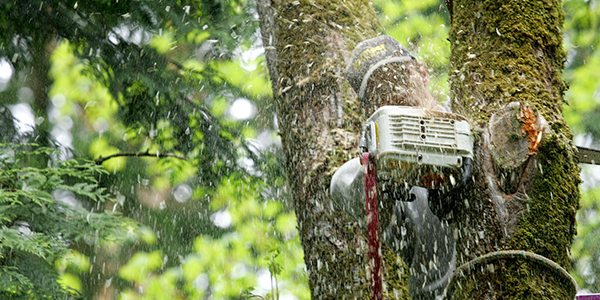
This is where specialized rope work matters. Our trained crew uses rigging to lower sections of the tree in a controlled sequence rather than dropping them. Each cut is planned based on the tree’s lean, weight distribution, and what’s directly below. For large trees near structures — a mature oak over a Levittown garage, or a tall pine leaning toward a Merrick roofline — this kind of precision isn’t optional. It’s what keeps a removal from becoming a homeowner’s insurance claim.
Tree felling contractors who skip this step, or who don’t have the equipment to do it properly, are the ones who end up damaging sprinkler heads, cracking fence posts, or worse. It’s worth asking any company you call exactly how they plan to handle the drop before they start.
We also take specific steps to protect what’s already on your property. That means marking sprinkler heads before equipment moves across the lawn, tarping ponds or water features near the work zone, and using ground protection where heavy machinery needs to travel. Nassau County lots don’t leave much margin for error, and we’ve been working around these conditions since 1998.
The difference between a tree cut done right and one done fast usually shows up in the cleanup — or in the damage you discover afterward.
Tree Debris Removal: What Should Be Included in Your Quote
One of the most common complaints about tree services — not just in Nassau County but everywhere — is that the crew took the tree down and left everything else behind. Brush piles on the lawn. Logs stacked in the driveway. Wood chips scattered across the garden beds. The homeowner assumed cleanup was part of the deal. It wasn’t in the contract.
Tree debris removal should be explicitly included in any written estimate. That means branches, logs, and chipped material are hauled off the property entirely. If you want to keep the firewood or use the chips for mulch, that’s usually an option — but the default should be a clean yard when the crew leaves, not a new project for you to manage.
When you’re comparing quotes, ask directly: does this price include full debris removal? If the answer is vague, that’s a signal. A legitimate tree removal service will tell you exactly what’s included and what, if anything, costs extra. Stump grinding, for example, is typically quoted as a separate line item.
We include complete debris removal on every job we do. Branches, logs, chips — all of it goes. The only thing left on your property when we’re done is a cleaner yard than when we started.
Nassau County Permit Requirements: What You Need to Know Before Any Tree Comes Down
Here’s something that catches Nassau County homeowners off guard: there is no single county-wide tree removal rule. Each of the three towns — Hempstead, North Hempstead, and Oyster Bay — along with the cities of Long Beach and Glen Cove, and dozens of individual villages, has its own tree protection ordinance. What’s required in one community may not apply two streets over.
Getting this wrong isn’t a minor inconvenience. Fines for unpermitted tree removal in Nassau County can reach $10,000 per tree. That’s not a worst-case scenario — it’s the actual maximum penalty written into local code.
Town-by-Town Permit Rules in Nassau County: Hempstead, North Hempstead, and Oyster Bay
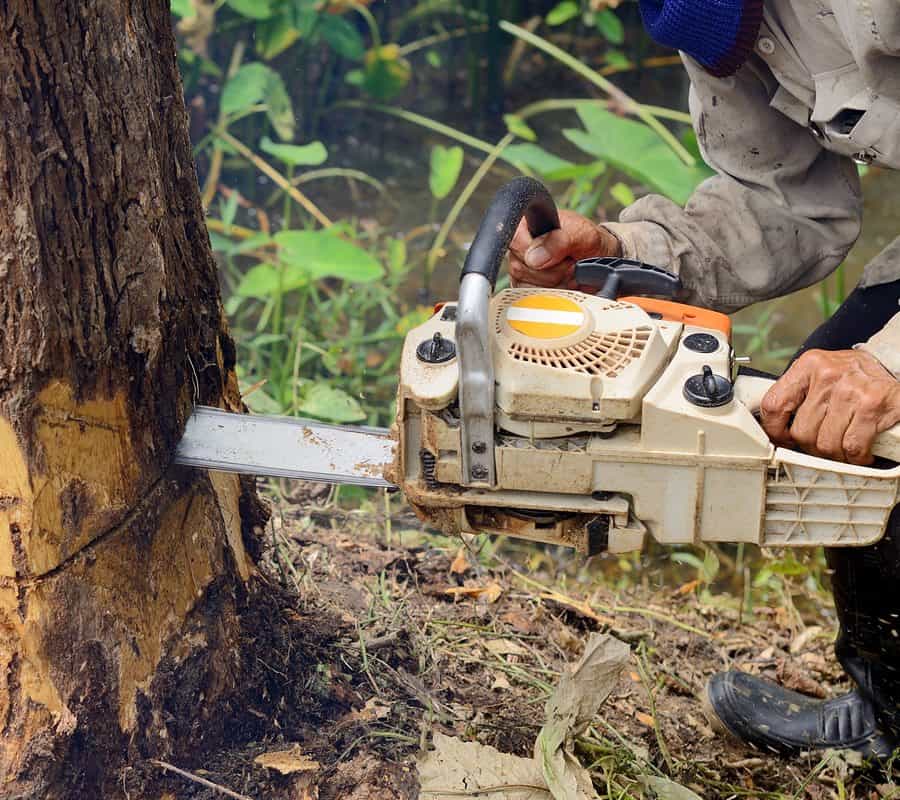
The Town of North Hempstead requires a permit for any front-yard tree with a trunk diameter of six inches or more, measured at four and a half feet above the base. Permit fees start at $25 for one to two trees and go up from there. Contractors applying for permits in North Hempstead must hold a Nassau County Home Improvement License and carry documented general liability, workers’ compensation, and disability insurance. Without that paperwork, the permit won’t be issued.
The Town of Oyster Bay triggers permit requirements at a trunk diameter of eight inches, measured at chest height. The Town of Hempstead has its own schedule under Chapter 184, with fines of up to $250 per tree plus mandatory replacement requirements for violations. Long Beach and Glen Cove each operate under separate municipal rules, and individual incorporated villages within these towns can add another layer on top.
If your property sits near a wetland, a designated historic district, or a protected natural area, you may also need sign-off from the New York State Department of Environmental Conservation before any work begins. Standard permit applications typically take ten to twenty days to process. Emergency permits for genuinely hazardous situations can sometimes be issued faster, but that’s not something to count on.
We handle the permit process as part of our service. After 26 years of working across Nassau and Suffolk County, we know which municipality requires what — and we know how to get the paperwork done so the job doesn’t stall.
The Insurance Gap That Can Make You Liable for a Worker's Injury on Your Property
Tree work is consistently ranked among the most dangerous occupations in the country. That’s a documented occupational safety fact. Which means the insurance question isn’t bureaucratic box-checking. It’s genuinely important.
Here’s the part most homeowners don’t know: if a tree crew without workers’ compensation insurance is injured on your property, you — the homeowner — can be held liable for their medical bills, lost wages, and rehabilitation costs. New York State workers’ compensation law is structured in a way that creates real financial exposure for property owners who hire uninsured contractors. It doesn’t matter that you didn’t know the crew was uninsured. It doesn’t matter that the injury wasn’t your fault.
Before any crew starts work on your property, ask for a Certificate of Insurance showing both general liability coverage and workers’ compensation. Request that the certificate be sent directly from the insurance company — not just a copy from the contractor, since fraudulent certificates exist. Minimum recommended coverage is $1 million per occurrence for general liability. Workers’ comp should cover every person on the crew.
We carry full general liability and workers’ compensation insurance and can provide proof before we start. It’s not something we make you ask twice for — it’s part of how we do business.
A cheap quote from an uninsured crew isn’t actually cheap when you factor in what you’re absorbing on their behalf.
How to Find the Best Tree Service Company in Nassau County
The best tree service company for your Nassau County property is one that handles the permits, carries the right insurance, gives you a written estimate that spells out exactly what’s included, and shows up with the equipment and experience to do the job without damaging what’s around it.
That combination is less common than it should be. Nassau County has no shortage of tree crews, but the ones who know the permit rules by municipality, carry workers’ compensation, and include complete debris removal in their quote — without being asked — are a shorter list.
If you have a tree that needs to come down, or you’re not sure whether it does, Competition Tree, Inc. has been handling residential and commercial tree removal across Nassau County since 1998. Call us directly and you’ll reach Rich, the owner, who can schedule a free on-site estimate — usually within a day.
—
**Frequently Asked Questions**
**Do I need a permit to remove a tree on my own property in Nassau County?** In most cases, yes. Nassau County doesn’t have a single county-wide rule — permit requirements vary by town and village. The Town of North Hempstead requires permits for front-yard trees six inches or wider in diameter. Oyster Bay’s threshold is eight inches. Hempstead has its own schedule. If you’re in Long Beach, Glen Cove, or one of Nassau County’s many incorporated villages, the rules may be different again. Skipping a permit can result in fines up to $10,000 per tree, plus mandatory replanting requirements. When in doubt, ask before you cut.
**What does low cost tree removal actually get you in Nassau County?** Sometimes a fair deal from a newer company building its reputation. More often, it means an uninsured crew, no permit knowledge, incomplete cleanup, or all three. The real cost of cheap tree removal shows up when a worker gets hurt on your property and you’re liable, when the stump is left behind because it wasn’t in the quote, or when a permit violation results in a fine that dwarfs whatever you saved. Value and price aren’t the same thing — especially in a county where the regulatory and liability exposure is this real.
**What does arborist insurance actually cover, and why does it matter to me as a homeowner?** An arborist’s insurance package should include general liability — which covers damage to your property or a neighbor’s during the job — and workers’ compensation, which covers the crew if someone is injured while working. In Nassau County, NY, if a tree crew without workers’ comp is hurt on your property, state law can hold you responsible for their medical costs and lost wages. Always request a Certificate of Insurance directly from the insurer before work begins.
**What does a certified arborist cost, and do I need one for tree removal?** Not every tree removal requires a certified arborist, but having one involved — whether on the crew or as part of the assessment process — adds a layer of expertise that matters for complex jobs, diseased trees, or situations where a permit application requires professional documentation. ISA Certified Arborists must have at least three years of documented field experience and pass a rigorous written exam. Their involvement typically adds to the overall project cost, but for large or complicated removals, it’s worth it. For a straightforward job on a healthy tree in a clear drop zone, an experienced licensed crew is usually sufficient.
**How much does an arborist cost per hour in Nassau County?** Arborist services in Nassau County are typically quoted by project rather than hourly rate, but when hourly rates are used — usually for consulting, health assessments, or expert testimony — expect to pay in the range of $75 to $150 per hour depending on credentials and scope. Full removal projects are almost always quoted as flat-rate jobs based on tree size, location, and complexity. Get a written estimate that breaks down what’s included.
Article details:
- Published by:
- Competition Tree
- Published to:
- Last modified:
- July 15, 2026
Share:
Continue learning:


