2026 Long Island Stump Removal Cost Guide
Stump removal quotes on Long Island vary wildly. Here's what actually drives the price difference — and what Nassau County homeowners need to know before calling anyone.
Share:
Summary:
You’ve already had the tree taken down. Now there’s a stump sitting in your yard — and you’re not sure what to do with it or what it’s going to cost. You’ve called around, and the quotes you’re getting don’t make any sense. One crew quoted you $175. Another wants $550. Nobody’s explaining why.
That’s not a you problem. That’s an industry problem, and it’s especially common here in Nassau County, where tight lots, local permit rules, and a wide range of operators make pricing harder to read than it should be. We’ve been doing this work for over 22 years, and we’ve seen every variation of that conversation. This guide gives you the honest breakdown, including what to expect from professional stump grinding and why costs can vary so much.
Stump Grinding vs. Full Stump Removal: What's the Actual Difference?
Most homeowners use “stump grinding” and “stump removal” like they mean the same thing. They don’t — and choosing the wrong one can create real problems down the road, especially on a Nassau County lot where every square foot counts.
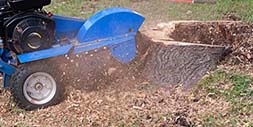
Stump grinding uses a rotating cutting wheel to shred the visible stump down to 6 to 12 inches below grade. The root system stays in the ground and decays naturally over time. What’s left behind is a mound of wood chips and a patch of ground that’s mostly level. It’s faster, less disruptive to the surrounding yard, and typically more affordable.
Full stump removal goes further. The entire stump and root ball are excavated — roots and all — using digging equipment or heavy machinery for larger trees. What remains is a crater that needs to be filled in. It’s more labor-intensive and costs more, but it leaves the ground completely clear. If the tree itself also needs to be addressed, professional tree removal is another service to consider.
Tree and Stump Removal Cost: Which Method Makes Sense for Your Property?
The right choice depends almost entirely on what you plan to do with that section of your yard afterward. If you’re just reclaiming the space — want to mow over it, plant grass, or stop looking at it — stump grinding is almost always the better call. It’s less invasive, the wood chips can be used as mulch or removed, and the roots underground aren’t going to cause problems for most homeowners.
Where it gets more complicated is when you have plans for that space. If you’re thinking about installing a patio, putting in a pool, or replanting a new tree in the same spot, the root system that grinding leaves behind can interfere. Roots from a large oak or maple — the kind that dominate yards in neighborhoods like Garden City, Oyster Bay, and Manhasset — can spread 20 to 30 feet from the base. If you’re building over that area, full removal or deeper excavation may be worth the extra cost upfront rather than dealing with complications later.
There’s also a pest consideration worth mentioning. A stump left above ground — or one ground only to surface level rather than well below grade — creates a slow-decaying food source for termites, carpenter ants, and wood-boring beetles. In Nassau County’s densely packed neighborhoods, where homes sit close together and share landscaping, a pest problem in a stump can migrate to your home or your neighbors’. Grinding to the proper depth (6 to 12 inches below grade, not just flush with the surface) eliminates that risk. A company that grinds only to ground level is cutting corners, and it’s worth asking specifically how deep they go before you agree to anything.
The soil under your yard also plays a role. South shore communities like Freeport, Massapequa, and Long Beach sit on sandy glacial outwash — roots tend to spread wide but not as deep. North shore communities like Port Washington, Great Neck, and Oyster Bay have heavier loam and clay, where roots can go significantly deeper and make full removal more labor-intensive. That’s a real cost factor that no national pricing guide accounts for, but it’s something any experienced Nassau County crew should be able to speak to.
Why Are Stump Removal Quotes So Different in Nassau County?
This is the question most homeowners are really asking when they search for stump removal cost. You’re not confused about tree stumps — you’re confused about why the quotes you’re getting are all over the map.
The short answer is that different companies are pricing different things. A $150 quote and a $550 quote for the same stump can both be legitimate — they just cover completely different scopes of work. The $150 quote might be grinding only, with debris left on your property, no permit handling, and a crew that grinds to surface level rather than below grade. The $550 quote might include grinding to proper depth, wood chip removal, cleanup, and a company that actually knows whether your municipality requires a permit.
Pricing in this industry typically runs $2 to $6 per diameter inch for stump grinding, which means a 20-inch stump might run $40 to $120 on the low end of that range — but most companies apply a minimum service fee of $80 to $160 regardless of stump size, and debris removal adds another $50 to $150 if it’s not included. For a single stump in Nassau County, an honest all-in estimate typically falls somewhere between $120 and $400, with larger hardwood stumps — the old oaks and maples common in established neighborhoods — running toward the higher end or beyond.
Full stump removal with root excavation costs more. Nationally, that ranges from $150 to $516 per stump, with root removal running $75 to $200 per hour when roots need to be extracted separately. On Long Island, where labor costs run higher than national benchmarks, expect the upper end of those ranges.
One thing that catches Nassau County homeowners off guard: permits. Most municipalities in Nassau County require a permit to remove a tree above a certain diameter — typically 6 to 12 inches depending on the specific village or township. Nassau County has 64 incorporated villages, each with its own rules. Permit fees generally run $50 to $200, and the process can take 10 to 20 days. Unpermitted work can result in fines up to $10,000 — and that fine lands on you, the homeowner, not the contractor who didn’t mention it. A low quote that skips the permit conversation isn’t saving you money. It’s shifting a risk onto you.
Stump Removal Near Me: What to Look for in a Nassau County Tree Service
When you’re searching for stump removal near me and scrolling through options, the price is the obvious thing to compare. But in Nassau County, where lots are small, homes are close together, and the consequences of a careless crew are real, a few other things matter just as much.
Licensing and insurance aren’t optional. An unlicensed operator who damages your fence, irrigation system, or neighboring property leaves you with no recourse. With median home values in Nassau County near $685,000, that’s not a risk worth taking over a lower quote. Ask for proof of general liability insurance and workers’ compensation coverage before anyone sets foot on your property.
Experience in this specific market matters too. A crew that works primarily in other regions won’t know Nassau County’s permit requirements, won’t recognize the soil conditions on your block, and won’t have the equipment access solutions that tight Long Island lots require. We’ve spent 22 years learning exactly how to navigate those constraints.

Stump Grinding Near Me: What a Complete, Honest Estimate Should Include
When you’re comparing stump grinding near me results and collecting estimates, the most important thing you can do is make sure you’re comparing the same scope of work — not just the bottom-line number.
A complete estimate should spell out the grinding depth (6 to 12 inches below grade, not flush with the surface), whether wood chip debris is removed or left on your property, whether cleanup is included, and whether the company handles permit research for your specific municipality. If an estimate doesn’t address those items, ask directly. The answers will tell you a lot about whether that company knows what they’re doing.
Multiple stumps are worth asking about specifically. The first stump typically carries the full service cost, but additional stumps on the same property are often priced at $30 to $60 each — a significant discount from the per-stump rate. If you have two or three stumps on your property, getting them handled in a single visit almost always makes financial sense.
Timing is also worth considering. Stump grinding is available year-round, but full stump removal — particularly the root excavation involved — gets meaningfully harder once the ground freezes. On Long Island, that window typically closes in late November or December. If you’re reading this in the fall and you’ve been putting off the call, that’s a real deadline. Frozen or frost-hardened soil significantly complicates excavation, and scheduling before the ground hardens gives you more options and typically a smoother job. Off-season winter scheduling, on the other hand, can sometimes yield savings of around 20% for homeowners who are flexible on timing and don’t need root excavation.
We provide free wood and wood chips with service — the chips are yours to use as mulch, or we remove them. Either way, there’s no add-on charge. That’s one less variable to negotiate.
What 22 Years on Long Island Has Taught Us About Stump Removal
We’ve been doing this work in Nassau and Suffolk Counties for over two decades. That’s not a credential we mention to fill space — it’s the reason we can tell you things about this market that a national franchise or a new crew simply can’t.
We know that a mature oak stump in Rockville Centre behaves differently than a silver maple in Levittown. We know which villages have permit offices that move quickly and which ones take the full 20 days. We know how to get equipment into a backyard in Woodbury or Lynbrook without tearing up the lawn or scratching the fence on the way in. These aren’t things you learn from a training manual. They come from showing up on Long Island properties, year after year, and doing the work.
Our customers regularly tell us they got 12 or more estimates before calling us. That’s not unusual in this market — Nassau County homeowners are thorough, and they should be. What they consistently find is that our estimate is honest, our scope is complete, and the price they’re quoted is the price they pay. No add-ons after the job starts, no surprises when the invoice arrives.
We’re fully licensed and insured, we offer free estimates with no obligation, and we’re available seven days a week — Monday through Sunday, 8am to 5pm. For storm-related emergencies, we’re reachable 24 hours a day. Nassau County’s coastal exposure — sitting between the Atlantic to the south and Long Island Sound to the north — means nor’easters and storm damage are a recurring reality here, not a once-in-a-decade event. When something comes down overnight, you shouldn’t have to wait until Monday.
Getting a Fair Stump Removal Estimate in Nassau County
The inconsistency you’ve seen in stump removal quotes isn’t random. It comes from companies pricing different scopes, skipping permit conversations, and leaving debris costs off the initial number. Once you know what a complete estimate should include — grinding depth, debris handling, permit research, and cleanup — the quotes become a lot easier to compare.
For most Nassau County homeowners, stump grinding is the right call. It’s effective, less disruptive to a small yard, and properly done at the right depth, it eliminates regrowth and pest risk. Full removal makes sense when you’re building, replanting, or dealing with a root system that would otherwise interfere with future plans.
If you’re ready to stop looking at that stump and get a straight answer on what removal will actually cost, Competition Tree, Inc. offers free estimates with no obligation. Give us a call and we’ll come take a look.
Article details:
- Published by:
- Competition Tree
- Published to:
- Last modified:
- October 8, 2026
Share:
Continue learning: