5 Things to Check Before Signing a Tree Removal Quote in Nassau County
Getting a tree removal quote in Nassau County? Here are five things every homeowner should verify before signing anything — starting with what most quotes quietly leave out.
Share:
Summary:
You’ve got a tree that needs to come down. Maybe it’s been leaning toward the house since the last nor’easter. Maybe it’s just dead and you’re tired of looking at it. Either way, you’ve started getting quotes — and now you’re staring at a range of numbers that don’t seem to have much in common with each other.
That range isn’t random. It usually means the quotes aren’t covering the same scope of work. Before you sign anything, here are five things worth checking. Getting these right upfront is the difference between a smooth job and a bill that keeps growing after the crew leaves.
What Tree Service Insurance Should Actually Cover
When a tree company tells you they’re insured, that’s the beginning of the conversation — not the end of it. In New York, any tree service company with even one part-time employee is legally required to carry workers’ compensation insurance. If they don’t, and someone gets hurt on your property, you can be held liable. That’s not a hypothetical — it’s a real exposure that Nassau County homeowners run into more often than they’d expect.
The right question isn’t “are you insured?” It’s “can you send me the certificate before work starts?” A legitimate company will have it ready. General liability and workers’ compensation are two separate policies, and you want to see both. The standard in this market is at least $1 million per occurrence for general liability, with professional operators typically carrying $2 million or more.
How to Verify a Tree Company's Insurance Before Work Begins
Asking for proof of insurance is easy. Knowing what to look for when you get it is the part most homeowners skip. When a company sends over a certificate of insurance, check three things: that the policy dates are current, that both general liability and workers’ compensation are listed as separate coverages, and that the coverage amounts are clearly stated.
If a company hesitates to provide the certificate — or tells you they’ll bring it on the day of the job — that’s worth paying attention to. A company that’s properly insured doesn’t need to stall. The certificate should come before any agreement is signed, not after the crew shows up.
It’s also worth knowing the difference between the two types of coverage. General liability protects your property if something gets damaged during the job — a fence, a roof, a neighbor’s car. Workers’ compensation covers the crew members themselves if someone is injured while working on your property. You need both. One without the other leaves a gap, and that gap is your problem if something goes wrong.
In Nassau County, where lots tend to be smaller and trees are often close to structures, fences, and neighboring properties, the stakes for having this right are higher than they might be on a larger rural lot. A tree coming down in sections near a driveway or a shared fence line is a more complex job than it looks, and the insurance behind it needs to match that complexity.
We carry both general liability and workers’ compensation coverage, and we’re happy to provide the certificate before any work begins. That’s not a favor — it’s just how a legitimate tree service should operate.
Tree Felling vs. Sectional Removal — Why the Method Matters in Nassau County
Tree felling means cutting the tree at the base and letting it fall. It’s faster, and it’s cheaper — which is part of why some quotes come in lower than others. But in most Nassau County neighborhoods, felling isn’t actually an option.
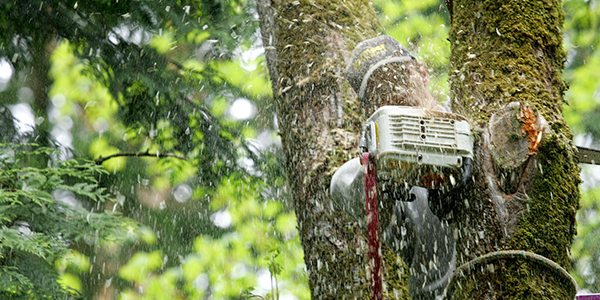
Lots in Garden City, Massapequa, Lynbrook, and Valley Stream don’t have the open space to let a large tree fall freely without risking damage to a structure, a fence, a driveway, or a neighbor’s yard. The alternative — and the professional standard in dense suburban areas — is sectional removal. That means cutting the tree in sections from the top down, controlling where each piece lands. It takes longer and requires more equipment, but it’s the right approach when a tree is anywhere near a house, a utility line, or a shared property line.
Here’s why this matters when you’re reviewing a quote: if a company is pricing a felling job but your tree can’t realistically be felled safely, one of two things will happen. Either they’ll attempt it anyway and hope for the best, or they’ll get on-site, realize it’s not feasible, and come back to you with a revised number. Neither outcome is good.
When you get a quote, ask directly: how are you planning to remove this tree? The answer should be specific to your property, not a generic response. If the company hasn’t actually looked at the tree and the surrounding space before quoting, that’s a sign the number they’ve given you isn’t reliable.
We use a 50-inch aerial bucket for complex removals — jobs where the tree is close to the house, near power lines, or in a tight space with limited room to work. It lets us do sectional removal cleanly and safely in exactly the kinds of situations that come up constantly in Nassau County neighborhoods.
Tree Removal Permits in Nassau County — Who's Responsible and What Happens If You Skip It
This is the part most homeowners don’t find out about until it’s too late. Nassau County doesn’t have a single county-wide tree ordinance. Each town and village sets its own rules, which means what’s required in North Hempstead is different from what’s required in Oyster Bay or Hempstead. Some permits cost $25. Some municipalities require replanting. And fines for removing a tree without the proper permit can reach $10,000.
The question to ask any tree service before signing is simple: who is pulling the permit, and will that be confirmed in writing? If a contractor tells you not to worry about permits, that’s not reassurance — that’s a red flag.
Permit Requirements Vary by Town — What Your Nassau County Municipality Requires
The Town of North Hempstead requires a permit for any front-yard tree with a trunk diameter of 6 inches or more, measured at 4.5 feet above the base. Permit fees start at $25, but the process typically takes 10 to 20 days from application to approval. If you need a tree removed before a pool installation, a fence project, or any other scheduled work, that lead time has to be factored in from the start.
The Town of Oyster Bay has its own requirements — including a noncommercial permit fee starting at $25 — and often requires stump grinding and replanting as conditions of approval. That surprises a lot of homeowners who assume the permit is just a formality.
The Town of Hempstead operates under Chapter 184 of its code, which has its own thresholds and procedures. And if your property is in an incorporated village — which many Nassau County properties are — there may be an additional layer of village-level rules on top of the town ordinance.
The point isn’t to make this seem more complicated than it is. It’s to make clear that “we’ll handle it” isn’t a complete answer. You want to know specifically who is filing the permit application, whether the permit fee is included in your quote or billed separately, and what the plan is if approval takes longer than expected. Get that in writing before the job starts.
Unpermitted tree removal doesn’t just expose you to fines. It can create problems when you go to sell your home — title searches sometimes surface permit violations, and that’s a headache no one wants to deal with years after a tree came down.
We know the permit landscape across Nassau County municipalities because we’ve been working in this market for over 20 years. When we quote a job, we tell you upfront what’s required in your specific town or village — and we don’t leave you to figure that part out on your own.
What a Complete Tree Removal Quote Should Include — and What's Often Left Out
This is where a lot of homeowners get burned. The number on a quote can look reasonable until you realize it only covers cutting the tree down. Stump grinding is almost always a separate line item — and it typically adds $100 to $400 per stump depending on size and depth. Debris haul-away, wood chip removal, and equipment surcharges can all be additional charges that weren’t visible in the original number.
A written, itemized quote should break out each component clearly: the removal itself, stump grinding, cleanup, debris disposal, and any permit fees that will be passed through to you. If a quote gives you a single number without explaining what’s included, ask for the breakdown. A company that won’t provide one is either not sure what the job entails or doesn’t want you to see what’s missing.
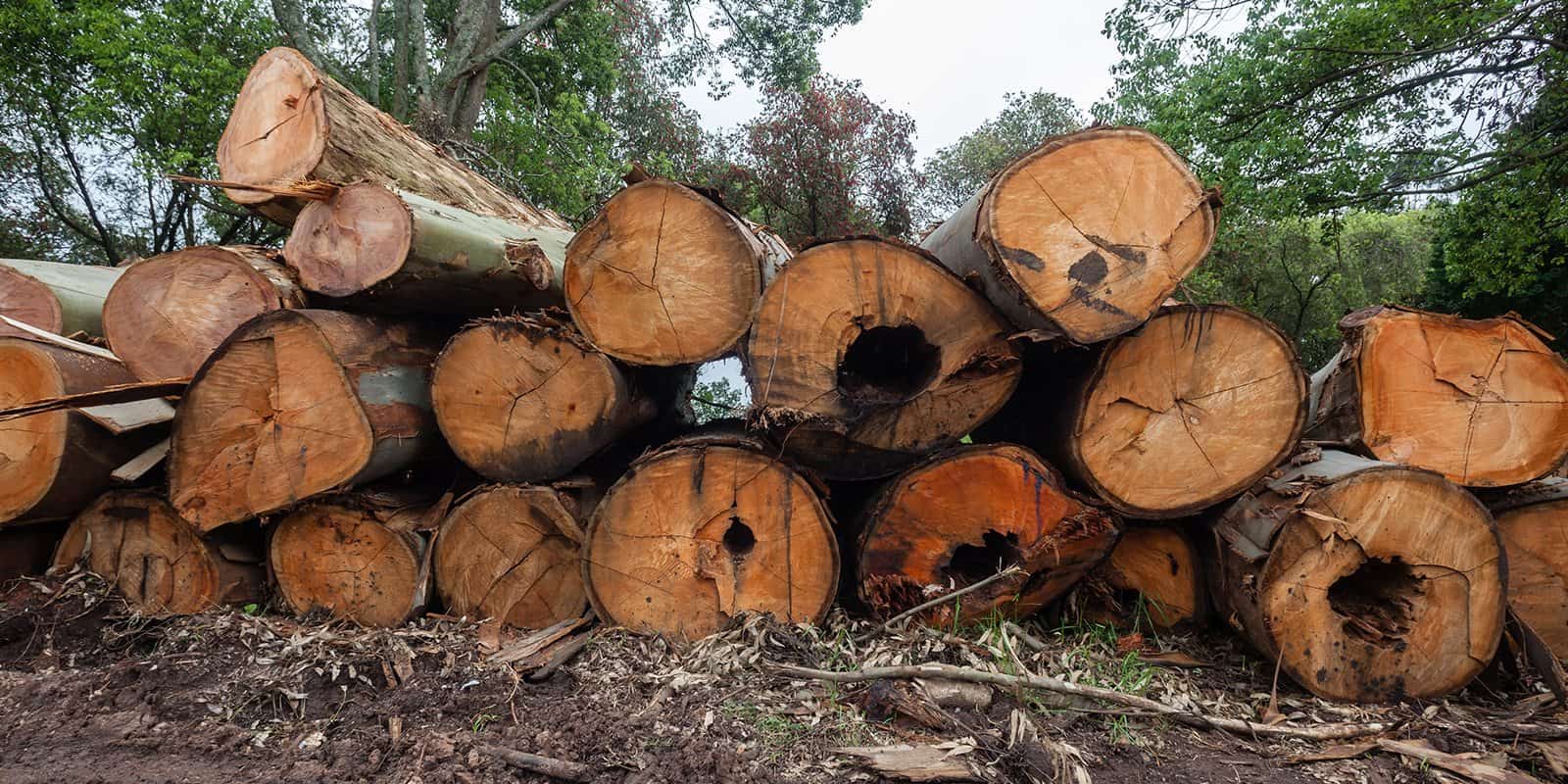
It’s also worth asking whether the wood and debris are being hauled away or left on your property. Some companies remove the tree and leave you with a pile of logs and a yard full of wood chips. That’s not cleanup — that’s half a job.
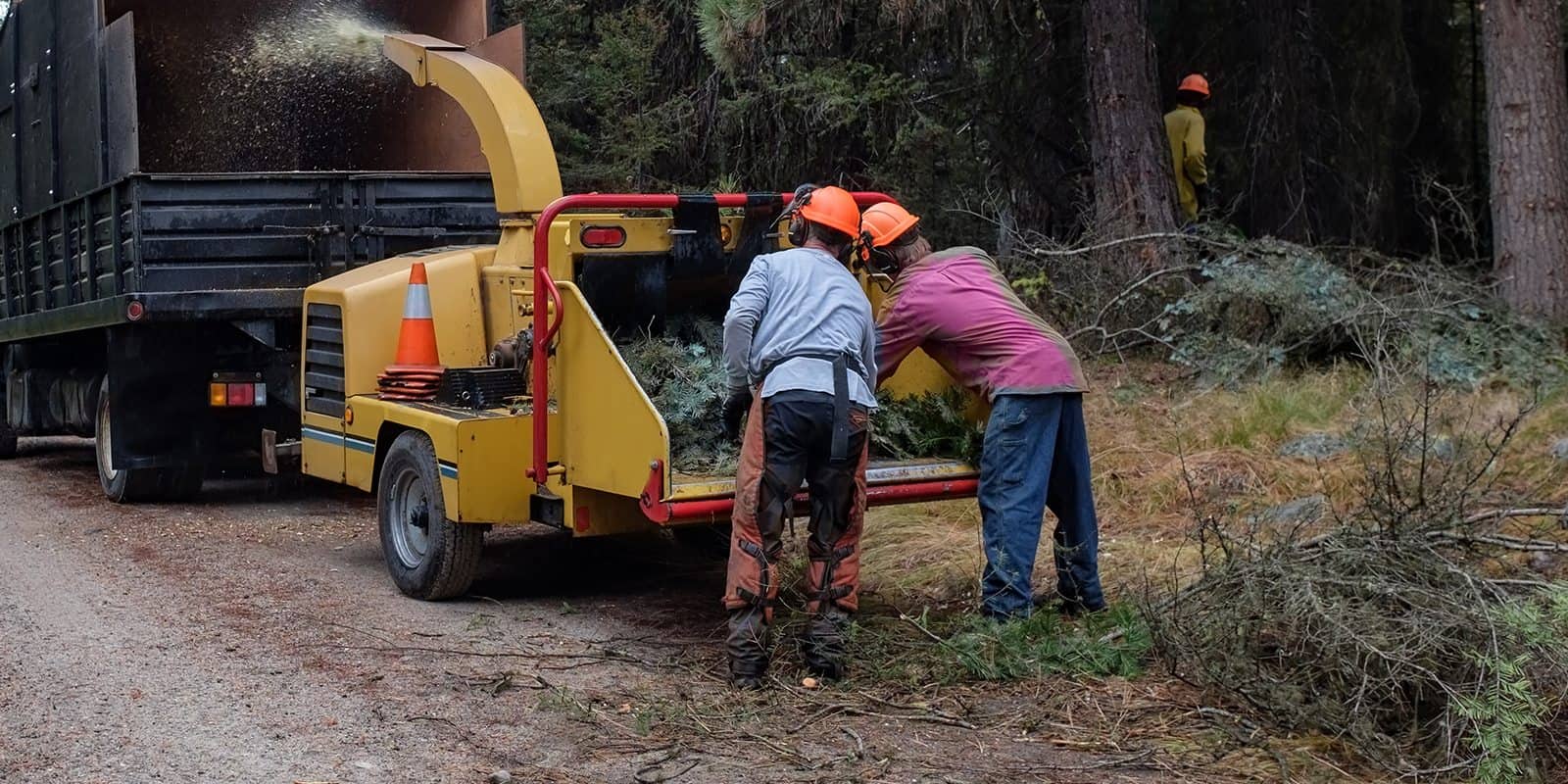
When we complete a removal, we take everything with us. We also offer the wood and wood chips to homeowners who want them — for firewood, garden mulch, whatever’s useful. If you don’t want them, they leave with us. Either way, the yard is clean when we’re done.
One more thing to check: whether the quote is based on an actual site visit or a phone estimate. A number given over the phone without anyone seeing the tree, the lot, or the surrounding conditions isn’t a real quote — it’s a guess. The final bill on a phone estimate can look very different from the number you agreed to. We provide free on-site estimates because there’s no other honest way to price a job accurately.
Before You Sign a Tree Removal Quote, Ask These Five Questions
Getting the right tree service comes down to knowing what to ask before you commit. Request the insurance certificate — both general liability and workers’ compensation — before work begins. Confirm who is handling the permit and whether the fee is included in your quote. Make sure the quote is itemized, covers stump grinding and cleanup, and is based on an actual visit to your property, not a phone call.
Nassau County’s dense neighborhoods, mature tree stock, and patchwork of municipal permit rules make this a market where the details matter more than most. A quote that doesn’t account for those details isn’t protecting you — it’s leaving you exposed.
If you have a tree that needs to come down and you want a straight answer on what it’s going to take, Competition Tree, Inc. offers free on-site estimates with no obligation. We’ve been doing this work on Long Island for over 20 years, and we’re happy to walk you through exactly what’s involved before you sign anything.
Article details:
- Published by:
- Competition Tree
- Published to:
- Last modified:
- August 7, 2026
Share:
Continue learning: