Certified Arborist Tree Care Standards Explained
Not every tree service is equal. Here's what ISA certification actually means, what it costs, and how to spot the real professionals in Nassau County.
Share:
Summary:
Most homeowners don’t think about their trees until something forces them to — a branch comes down in a storm, a tree starts leaning toward the house, or a neighbor mentions something that’s been nagging at you for months. Then you start searching, and suddenly you’re looking at a dozen tree service companies with no clear way to tell them apart. After a tree is removed or heavily pruned, professional wood chipping services can efficiently recycle branches and debris into useful mulch, leaving your property clean and tidy.
That’s where certification matters. Understanding what a certified arborist actually is — and what it means for the work being done on your property — can save you from a bad hire, a fine from your municipality, or a tree that never recovers. Here’s what you need to know.
What Certified Arborist Tree Care Actually Means
The title “certified arborist” isn’t just a marketing phrase. It refers specifically to a credential issued by the International Society of Arboriculture — the ISA — which has been setting professional standards in the arboriculture industry since 1924. To earn it, a candidate needs at least three years of full-time experience in professional tree care, or a relevant degree plus documented field experience. Then they have to pass a 200-question exam covering tree biology, pruning technique, soil science, pest and disease identification, risk assessment, and safe work practices.
That’s not a weekend course. It’s a meaningful professional threshold. And because ISA certification expires every three years, certified arborists have to earn 30 continuing education units each cycle just to keep the credential active. That means the person working on your trees is staying current — not relying on what they learned a decade ago.
How to Find an ISA Certified Arborist and Verify Their Credentials
Here’s something most homeowners don’t know: you can verify any arborist’s ISA certification yourself, for free, before you ever sign a contract. The ISA maintains a public directory at treesaregood.org where you can search by name, location, or certification number and confirm that the credential is current and legitimate. It takes about two minutes and removes all the guesswork.
Why does this matter? Because anyone can claim to have a certified arborist on staff. The claim costs nothing. But the certification number is tied to a specific individual — it’s not a company-level badge that gets passed around. When you’re comparing tree service companies, asking for that number and checking it yourself is one of the most straightforward ways to separate professional operations from the rest.
Beyond ISA certification, there are a few other things worth confirming before work begins. A legitimate tree service should carry both general liability insurance and workers’ compensation coverage — and should be willing to provide certificates before anyone touches your property. If a worker is injured on your land and the company doesn’t carry workers’ comp, that liability can fall back on you as the homeowner. That’s not a hypothetical risk; it’s a real one.
You should also ask whether the company holds a Nassau County Home Improvement License. Most municipalities in Nassau County — including the Town of North Hempstead — require this license before they’ll issue a tree removal permit. If the contractor you’re hiring can’t pull a permit on your behalf, you may be the one facing a fine when the job is done.
Nassau County’s patchwork of tree ordinances is worth taking seriously. The county encompasses over 60 incorporated villages and three towns, each with its own rules around which trees require permits, what diameter triggers the requirement, and what the fines look like for violations. In many municipalities throughout Nassau County, removing a tree over a certain caliper without a permit can result in fines up to $10,000. A contractor who knows Nassau County’s specific regulatory landscape isn’t just a convenience — they’re a form of protection.
What ANSI A300 Standards Mean for the Work on Your Property
ISA certification tells you about the person. ANSI A300 tells you about the work. The American National Standards Institute publishes the A300 Tree Care Standards — the industry benchmark for how tree pruning, fertilization, support systems, and root management should actually be performed. ISA Certified Arborists are trained to follow these standards. Most uncertified contractors have never heard of them.
One of the clearest examples of why this matters is tree topping — the practice of cutting large branches back to stubs to reduce a tree’s size. It’s common among uncertified operators and it’s genuinely harmful. Topping creates large open wounds that invite disease and decay, triggers the growth of weakly attached shoots that are more structurally dangerous than the original branches, and permanently disfigures the tree’s structure. No certified arborist following ANSI A300 standards will recommend it. But if you hire someone who doesn’t know the difference, you may end up paying to have your tree damaged rather than cared for.
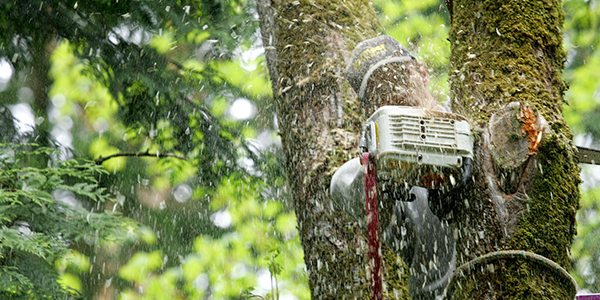
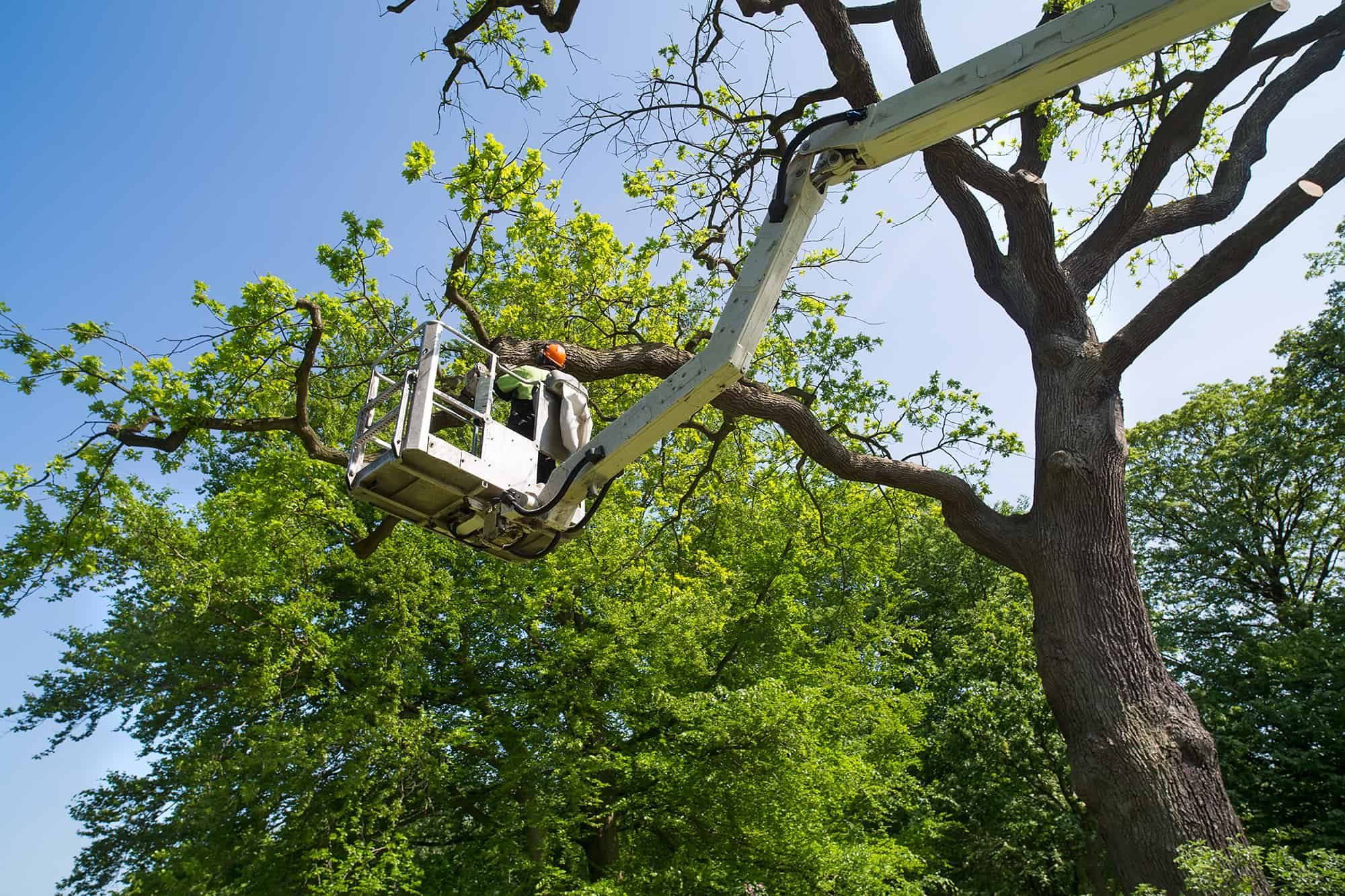
The same principle applies to pruning cuts, removal techniques, and how work is performed near structures, utilities, and neighboring properties. In Nassau County’s dense suburban neighborhoods — where lots are tight, driveways are narrow, and a tree removal might happen ten feet from a fence or a pool — the method of work matters as much as the outcome. Professional tree felling contractors who follow ANSI standards use techniques like specialized rope work to control exactly where and how a tree comes down, rather than just dropping it and hoping for the best. That level of precision is what distinguishes a credentialed operation from a crew that’s simply fast with a chainsaw.
Mature trees in Nassau County also face specific pest and disease threats that require trained eyes to catch early. The Emerald Ash Borer has been spreading across Long Island and poses a serious threat to ash trees throughout the county. Hemlock Woolly Adelgid threatens hemlocks. These aren’t problems a general landscaper is trained to identify or treat — but a certified arborist is.
What the Best Tree Service Company Actually Looks Like
Certification is the floor, not the ceiling. The best tree service companies combine ISA credentials with the kind of operational reliability that makes working with us straightforward — fast responses, honest assessments, clean work, and no surprises on the invoice.
Homeowners in Nassau County tend to be thorough researchers. They read reviews, compare estimates, and ask the right questions. And the feedback that shows up consistently in reviews for quality tree services isn’t just about the technical work — it’s about responsiveness, transparency, and whether the crew left the property the way they found it.

Nassau County's Tree Canopy Has Specific Demands — Your Tree Service Should Know Them
A lot of Nassau County’s residential tree canopy is old. The county’s suburban neighborhoods were largely developed in the postwar decades — the 1940s through the 1960s — which means trees planted during that era are now 60 to 80 years old. They’re large, they’re mature, and in many cases they’re approaching the end of their structural lifespan. That’s not a reason to panic, but it is a reason to work with someone who can actually assess what’s going on rather than just quoting you a removal price over the phone.
Hurricane Sandy in 2012 reshaped how a lot of Long Island homeowners think about their trees. The storm caused catastrophic damage across Nassau County and made it viscerally clear that a large tree near a house isn’t just a landscape feature — it’s a potential liability. Since then, hazard assessments and proactive pruning have become a much more common conversation. A certified arborist can evaluate a tree’s structural integrity, identify signs of internal decay, and tell you honestly whether removal is necessary or whether targeted pruning would address the risk.
That honest assessment piece is actually one of the more underrated things a certified arborist brings to the table. There’s no shortage of tree service companies that will tell you a tree needs to come down when it doesn’t. A professional with real training in tree risk assessment has both the knowledge and the professional ethics — ISA has a formal Code of Ethics — to give you an accurate picture of what your tree actually needs.
Beyond individual trees, a knowledgeable local tree service should understand how Nassau County’s coastal geography affects the work. High water tables, salt air exposure in communities like Long Beach, and the county’s storm exposure all affect how trees grow, how they fail, and what care they need. That’s the kind of contextual knowledge that comes from years of working in a specific place — not from reading a manual.
Certified Arborist Cost: What to Expect and Why It's Worth It
Cost is a fair question and it deserves a straight answer. Nationally, hiring a certified arborist runs an average of around $875, though the range is wide — from a few hundred dollars for a consultation or small job to several thousand for complex removals near structures or utilities. Hourly rates for certified arborists typically fall between $100 and $250, depending on the scope of work, the size of the tree, and the complexity of the site. A written site analysis or formal tree health report for a single tree usually runs $250 to $400.
In Nassau County specifically, you also need to factor in permit costs, which typically range from $25 to $200 depending on the municipality and the number of trees involved. The permit process for standard removals usually takes 10 to 20 days, though emergency permits can move faster. A tree service that knows Nassau County’s permitting process can handle this on your behalf — which is worth something when you’re trying to get a hazardous tree dealt with efficiently.
The honest case for spending a bit more on a certified arborist isn’t complicated. Improper pruning can permanently shorten a tree’s lifespan and invite disease. An uncertified crew that drops a tree without proper technique can damage a fence, a car, a neighbor’s property, or a utility line. An uninsured worker injured on your property can create a liability claim that dwarfs whatever you saved on the original quote. And a contractor who removes a tree without pulling the required permit can leave you holding a fine of up to $10,000 in Nassau County.
The upfront cost difference between a credentialed, insured, licensed tree service and an uncertified one is usually modest. The potential downside of getting it wrong is not. That’s the math most homeowners land on once they think it through — and why searching for a certified arborist in the first place is the right instinct.
Finding Qualified Tree Care in Nassau County, NY
The short version: ISA certification is the most reliable credential in the tree care industry, verifiable in two minutes at treesaregood.org. It means the person working on your trees has earned real qualifications — not just bought a truck and some equipment. Combined with proper insurance, a Nassau County Home Improvement License, and genuine local experience, it’s the clearest signal that a tree service knows what it’s doing.
Nassau County’s dense neighborhoods, aging tree canopy, and strict local ordinances make this more than a general recommendation. It’s practical protection for your property and your finances.
If you’re looking for a tree service that brings all of this together — credentials, local knowledge, honest assessments, and a crew that actually cleans up after itself — we’ve been doing exactly that on Long Island for over 22 years. Give us a call and we’ll get back to you the same day.
Article details:
- Published by:
- Competition Tree
- Published to:
- Last modified:
- August 7, 2026
Share:
Continue learning: