What a Tree Removal Estimate Actually Includes
Getting a tree removal estimate is easy. Understanding what it actually covers — and what it doesn't — is where most homeowners get caught off guard.
Share:
Summary:
You’ve got a tree that needs to come down. Maybe it’s leaning toward the house, maybe it’s been dead for two seasons, or maybe a storm just made the decision for you. You call around, get a few numbers, and suddenly you’re looking at quotes that range from $600 to $2,200 for what sounds like the same job.
That gap isn’t random — and it’s not just one company trying to rip you off. It usually comes down to what each estimate actually includes. Understanding that difference before you commit is one of the most useful things you can do as a homeowner.
Tree Removal Prices: Why No Two Quotes Are the Same
Tree removal prices aren’t standardized. There’s no published rate sheet, no industry-wide formula, and no two jobs that are exactly alike. What you’re actually paying for is a professional assessment of your specific tree, your specific property, and everything that could complicate the work.
In Nassau County, where most properties are densely developed and mature trees often grow close to structures, fences, driveways, or a neighbor’s yard, that complexity adds up fast. A tree in an open field is a very different job than the same-sized tree wedged between a garage and a power line easement. That’s why we always insist on an on-site visit before quoting — the numbers only make sense when we’ve seen what we’re actually working with.
What a Legitimate On-Site Estimate Actually Looks At
A real estimate isn’t something we can give accurately over the phone or from a photo — at least not for anything beyond a straightforward small tree in an open yard. For most residential jobs in Nassau County, we need to be standing in front of the tree to give you a number that will actually hold.
Here’s what a thorough on-site assessment covers:
The first thing is tree size — not just height, but the diameter of the trunk, the spread of the canopy, and the overall volume of wood that needs to come down. A tall, narrow tree and a shorter but wide-canopied tree can be very different jobs in terms of labor and time.
Species matters too. Some trees are harder to work with than others. Dense hardwoods like oak and beech take longer to cut and process than softer species. Pitch pine, which is common throughout Long Island, can be unpredictable due to its resin content. We account for this in our estimates.
Site accessibility is where Nassau County’s density really comes into play. Can a truck and chipper get close to the tree? Is it near overhead lines? Is there a fence or structure directly in the drop zone? Trees that require sectional removal — cutting piece by piece from the top down rather than felling in one direction — take significantly more time and sometimes require specialized equipment like an aerial bucket.
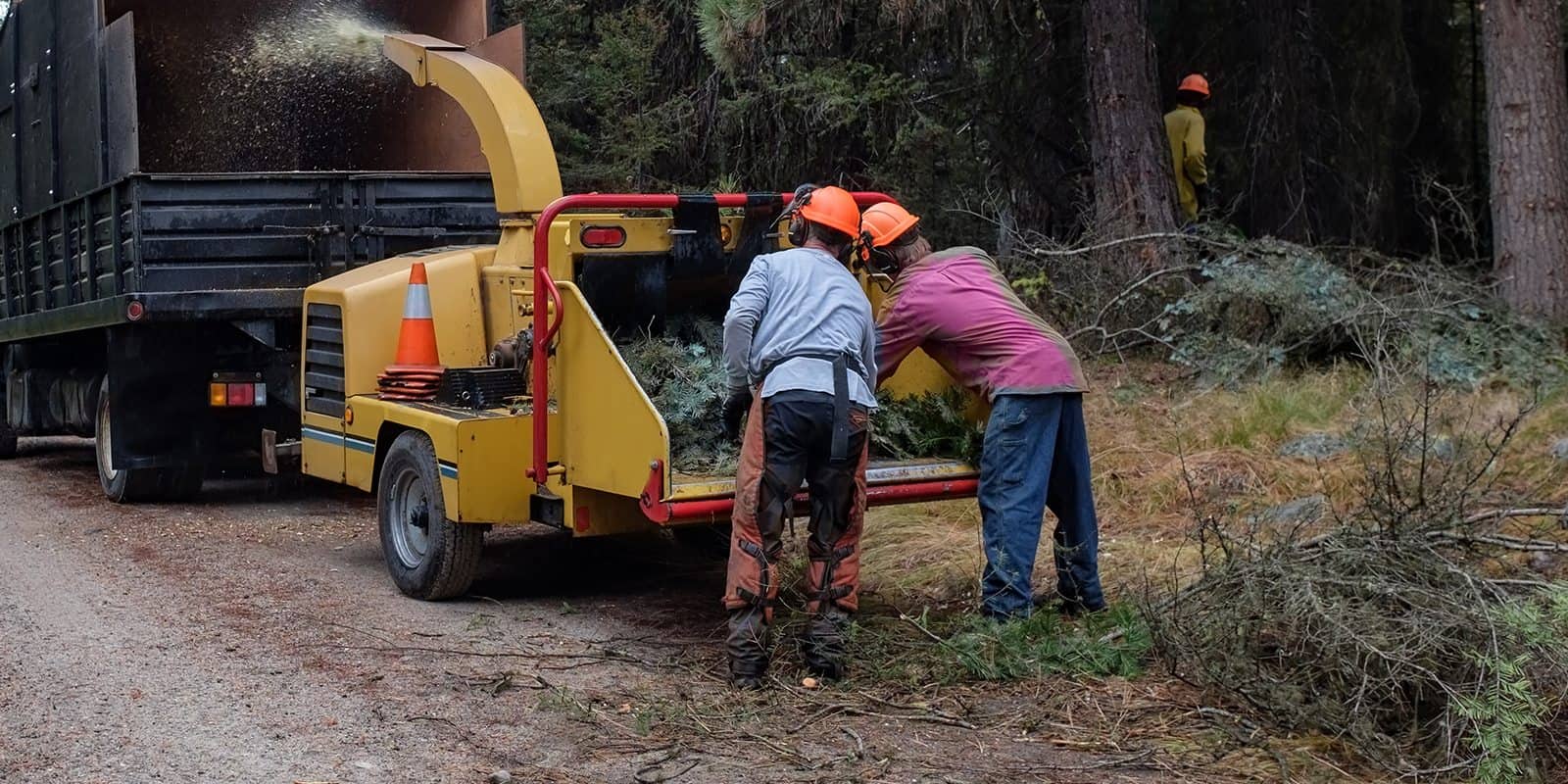
Then there’s debris. This is the most commonly misunderstood part of a tree removal estimate. When you get a quote from us, you need to know whether it includes chipping the branches, hauling the logs, and cleaning up the site — or whether it just covers bringing the tree down. The difference between a quote that includes full debris removal and one that doesn’t can be meaningful, and we make sure that’s spelled out clearly before any work begins.
Finally, stump grinding is almost always a separate line item. A quote for “tree removal” typically means the tree comes down to ground level. The stump stays unless you specifically ask about grinding, and the cost to grind it is quoted separately based on the diameter of the stump.
The Nassau County Permit Factor Most Estimates Leave Out
This is the part that catches Nassau County homeowners off guard more than almost anything else — and it’s rarely addressed in the estimate itself unless you’re working with a company that actually knows the local regulatory landscape.
Nassau County isn’t governed by a single set of tree removal rules. It contains three towns — Hempstead, North Hempstead, and Oyster Bay — plus two cities and more than 60 incorporated villages, each of which can layer its own ordinances on top of the town-level requirements. What’s permitted in one neighborhood may require a formal application in the next one over.
Most townships require a permit to remove trees above a certain trunk diameter — typically somewhere between 6 and 12 inches, depending on your specific location. Permit fees generally run $50 to $200 per tree. That’s not a huge number on its own, but it’s also not zero, and a low estimate that doesn’t account for it isn’t a complete estimate. More importantly, skipping a required permit isn’t just a paperwork issue — fines for unpermitted tree removal can reach $10,000 in some Nassau County jurisdictions.
The permit process also takes time. Standard applications typically run 10 to 20 days. If you’re planning a removal around a project or a specific date, that timeline needs to be built into the plan from the start, not discovered after the fact.
When we provide an estimate, we factor in whether a permit is required for your specific address, what the fee will be, and how the timeline affects your job schedule. If you’re working with another company and they don’t bring this up, it’s worth asking directly.
Tree Felling Cost vs. Full Removal: Understanding What You're Comparing
“Tree felling” and “tree removal” sound interchangeable, but they’re not always the same thing in practice. Felling refers specifically to cutting the tree down — bringing the trunk and major branches to the ground. Full removal typically implies that the site is cleaned up and the debris is gone when the crew leaves.
When you’re comparing quotes, it’s worth confirming which one you’re actually getting. A felling-only quote is often lower, but it leaves you responsible for dealing with the wood, branches, and whatever’s left on the ground. That might be fine if you want the logs for firewood — but it’s worth knowing upfront, not after the crew leaves.

How to Estimate Tree Removal Cost Before You Call
Before you pick up the phone, it helps to have a rough sense of what you’re dealing with. Tree removal cost in Nassau County typically ranges from $500 to $2,300, with the average landing around $1,400 for a standard residential job. That’s a wide range, and it reflects just how much the variables described above can shift the final number.
Nationally, most homeowners pay somewhere between $400 and $1,200 for a standard removal. Per-foot pricing is a common benchmarking tool — industry figures generally run $9.50 to $14.50 per foot of tree height, though challenging situations involving tight access, proximity to structures, or the need for crane assistance can push that higher.
Large trees — those over 80 feet — often require crane assistance, which adds roughly $500 or more to the total. Trees near power lines or structures require sectional removal, which is more labor-intensive than a straightforward fell. These aren’t upsells; they’re real cost drivers that a legitimate estimator will identify during the site visit and explain clearly in the written quote.
The most useful thing you can do before calling for estimates is walk your property and take stock of what’s actually there. How tall is the tree? How close is it to the house, the fence, the driveway? Is there clear access for a truck? The more clearly you can describe the situation, the more useful the initial conversation will be — and the less likely you are to be surprised when the estimator shows up and sees something you didn’t mention.
One more thing worth knowing: stump grinding averages around $326 as a standalone job, though it varies by stump diameter. If you want the stump gone, ask for that to be quoted separately and make sure it’s included in the written estimate if you want it done.
Red Flags That Tell You an Estimate Isn't Complete
Not every low quote is a scam. But some are — and Nassau County homeowners are particularly exposed after major storms, when unlicensed operators move through residential neighborhoods quickly, going door to door with urgent pitches and prices that seem too good to pass up.
There are a few things that should give you pause regardless of the price.
An estimate given without an on-site visit is a significant red flag for any job involving a large tree, a tree near a structure, or anything with complicated access. A number given over the phone or based on a single photo isn’t a real estimate — it’s a placeholder that can change once the crew arrives and sees what they’re actually dealing with.
A verbal-only quote with nothing in writing is another warning sign. A complete written estimate should spell out the total cost to bring the tree down, whether stump grinding is included or quoted separately, what happens to the debris, and what is explicitly not included in the price. If you can’t see those line items in writing before you agree to anything, you don’t actually know what you’re buying.
Be cautious if a company asks for a large deposit upfront — more than 10 to 20 percent before any work is done is outside normal industry practice.
Always ask for proof of liability insurance and workers’ compensation coverage before anyone starts work on your property. This isn’t just about protecting the tree company — it’s about protecting you. If a crew member is injured on your property and the company doesn’t carry workers’ compensation, the liability can fall on you as the homeowner. A legitimate company will provide proof of coverage without hesitation.
Getting a Tree Removal Estimate You Can Actually Trust
A good estimate isn’t just a number — it’s a clear, written account of exactly what will happen on your property, what it will cost, and what’s not included. When you understand the five inputs that go into a legitimate quote, you’re in a much better position to evaluate what you’re actually being offered and why two estimates for the “same job” can look so different.
In Nassau County especially, where permit requirements vary by township and village, where mature trees regularly grow in tight quarters near structures, and where post-storm demand brings out operators who aren’t always who they say they are, knowing what to look for matters.
We’ve been doing this work across Nassau County for over 22 years. If you want a free, on-site estimate from Competition Tree, Inc., we’re ready to take a look at your property. No pressure, no guesswork — just a straight answer about what the job involves and what it will cost.
Article details:
- Published by:
- Competition Tree
- Published to:
- Last modified:
- July 15, 2026
Share:
Continue learning: