Crane vs Climbing Tree Removal in Nassau County: Which Method Wins?
Not every tree comes down the same way. Here's how to know which removal method actually fits your situation — and why it matters more than you think.
Share:
Summary:
If you’ve got a large tree that needs to come down — one that’s leaning toward your roof, sitting over your pool, or crowding a fence line — you’ve probably already realized this isn’t a simple job. The question most homeowners eventually land on isn’t just “how much will this cost?” It’s “how is this thing actually coming down without taking half my yard with it?”
Crane-assisted removal and traditional climbing are both legitimate methods. But they’re not interchangeable. The right choice depends on your tree, your property, and what’s around it. Here’s what you need to know.
Tree Removal Methods: Crane vs. Climbing Comparison
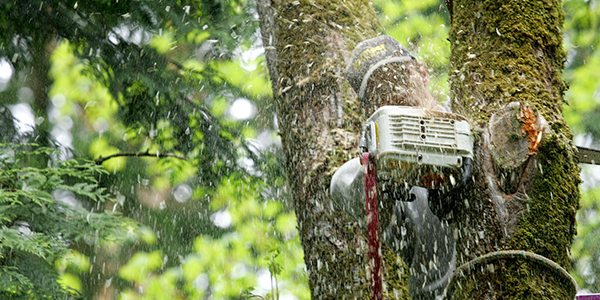
At the most basic level, tree removal comes down to how you control where each piece of the tree goes. With climbing, a trained arborist ascends the tree, cuts it down in sections from the top, and uses ropes and rigging to guide each piece to the ground. It’s skilled, precise work — and for the right tree in the right setting, it’s completely effective.
Crane-assisted removal works differently. A crane is positioned near the tree, and a climber attaches sections to the crane’s line before cutting. Instead of lowering pieces by rope, the crane lifts them out entirely — clearing structures, fences, landscaping, and anything else in the way. The sections get carried to a drop zone where they can be safely processed. It’s slower to set up, but dramatically more controlled once it’s running.
There’s also a third option that doesn’t get talked about enough: specialized rope rigging. For trees in genuinely tight spaces — where a crane can’t position and a straight felling cut is out of the question — advanced rigging techniques can thread sections out of spaces that seem impossible. It’s worth knowing this exists before assuming a crane is the only answer.
Tree Climbing Service: When It's the Right Call
Climbing works best when a tree is structurally sound, reasonably accessible, and not directly over anything that can’t take a hit. A healthy oak in an open backyard with decent clearance around it? A climber can handle that efficiently, and the job will likely cost less than a crane setup.
The advantages of climbing go beyond price. A skilled climber can work in spaces where crane access simply isn’t possible — narrow side yards, properties with limited street access, or areas where overhead lines make crane positioning impractical. Setup is faster, and for smaller or mid-sized trees, the whole job can move quickly.
That said, climbing has real limitations that homeowners don’t always anticipate. The most important one: a climber needs the tree to be structurally reliable enough to support their weight and the forces involved in cutting. A dead tree, a storm-damaged tree, or one with significant internal decay can fail without warning. When a section breaks unpredictably, there’s no margin for error if your house is ten feet away. That’s not a risk any responsible arborist should take — and it’s not one you want taken on your property either.
In Nassau County specifically, a lot of the trees that need removal are the ones that were planted alongside Levittown-era homes in the late 1940s and 1950s. Those trees are now 60 to 80 years old. Many of them look fine on the outside while carrying internal decay that only becomes obvious once the cutting starts. That’s exactly the scenario where climbing becomes the wrong choice, even if the tree looks manageable from the street.
Crane Assisted Tree Removal: The Scenarios Where It's Necessary
Crane removal isn’t an upgrade — it’s a necessity in certain situations. Understanding which situations those are helps you evaluate whether a recommendation is being straight with you or padding a quote.
The clearest case for crane work is a large tree directly over or adjacent to a structure. If a 90-foot oak is hanging over your roof in Levittown or Massapequa and there’s no safe angle to lower sections without them swinging toward the house, a crane removes that variable entirely. Each section gets lifted out, not swung down. That’s the difference between a controlled removal and a very expensive accident.
Dead and diseased trees are another non-negotiable. A dead tree is unpredictable — branches can snap without warning, and the structural integrity of the trunk itself may be compromised. Sending a climber up a dead tree is a serious safety risk. The fatal injury rate in tree work is already among the highest of any occupation in the country; crane removal exists partly because it keeps workers out of the most dangerous positions.
Trees near active power lines present a third scenario. In Nassau County, PSEG Long Island lines run through countless residential neighborhoods, and mature trees growing into or near those lines require precise, controlled removal. A crane gives the operator the ability to lift sections away from the lines rather than hoping a rope-guided section clears them cleanly.
Finally, there’s the simple reality of Nassau County lot sizes. The county’s suburban density means the average backyard doesn’t have much room to work with. When a large tree has no safe fall zone in any direction, crane removal isn’t an option you’re choosing — it’s the only option that makes sense.
Crane Assisted Tree Removal Cost: What You're Actually Paying For
Crane work costs more than climbing — that’s just true, and we won’t tell you otherwise. Tree removal in Nassau County typically runs somewhere between $500 and $2,300 depending on size and complexity. Add crane equipment and the coordination it requires, and larger jobs can push well past that range.
But the cost question worth asking isn’t “how much does the crane add?” It’s “what does the crane prevent?” A crane-assisted removal on a tree near your home, pool, or landscaping is also a form of property protection. The cost of repairing a roof, replacing a deck, or rebuilding a fence after a section lands wrong can dwarf the difference between crane and climbing quotes.
What Drives the Price Difference Between Crane and Climbing Removal
The crane itself is one factor — equipment rental and operation adds meaningful cost to any job. But the real driver of crane removal pricing is the coordination it requires. You need a trained crane operator and a certified arborist working in close communication throughout the job. Two distinct skill sets, running simultaneously. That’s not something every tree company can actually provide in-house.
Setup time is another factor people underestimate. Before a single cut is made, the crane has to be positioned carefully, outriggers deployed, and the ground stability assessed. In some setups, the outriggers lift the truck completely off the ground to distribute weight properly. That process takes time, and it should — rushing it creates serious risk.
There’s also the question of what’s included. A complete crane removal job should cover the entire process: assessment, setup, sectional removal, debris chipping, and full cleanup. If a quote is unusually low, it’s worth asking exactly what it covers. Leaving a property with a pile of logs and brush isn’t a completed job — it’s half of one.
For Nassau County homeowners, the value calculation often tips toward crane work faster than people expect. Small lots, mature trees, and homes that are close together mean there’s rarely a clean, open path for sections to fall. When the margin for error is tight, paying for precision isn’t a luxury — it’s the only sensible approach.
Nassau County Property Access: What Crane Removal Actually Requires
One of the most common questions we hear from homeowners in Hempstead, Rockville Centre, and Oyster Bay is whether their property can even accommodate crane equipment. It’s a fair concern — Nassau County neighborhoods aren’t exactly known for wide-open access.
Crane positioning requires enough clearance to get the equipment close to the tree and deploy the outriggers safely. That usually means a driveway, a side yard, or street access wide enough for the truck to reach the right angle. In tighter situations, the crane may need to work from the street with a longer reach. None of this is unusual — it just needs to be assessed on-site before the job starts, which is exactly why phone quotes for crane work are unreliable. Every property is different.
Ground conditions matter too. Nassau County’s high coastal water table means soil can be softer than it looks, particularly after rain or in low-lying areas near the south shore communities like Long Beach or Oceanside. Ground mats and protective measures are standard practice for responsible crane work — they distribute weight and protect driveways, lawns, and landscaping from equipment damage. If a company doesn’t mention property protection when they quote crane work, that’s worth asking about directly.
Permit requirements add another layer of planning. Nassau County tree removal is regulated at the township and village level, and the rules vary significantly across the county’s dozens of municipalities. Oyster Bay, North Hempstead, and Hempstead each have their own ordinances, and some villages layer additional requirements on top of those. Permits typically take 10 to 20 days for standard applications — though genuine emergencies can sometimes move faster. Failing to pull the right permit can mean fines up to $10,000. We know this landscape because we work in it every day.
Choosing the Right Tree Removal Method for Your Nassau County Property
There’s no universal answer to the crane vs. climbing question. The right method depends on the tree’s size and condition, what’s around it, how much access the property allows, and what the consequences of a mistake would be. For most large, mature trees in Nassau County’s dense residential neighborhoods, crane-assisted removal isn’t an upsell — it’s what the job actually calls for.
What matters most is working with someone who will assess your specific situation honestly, explain their recommendation clearly, and have the equipment and experience to back it up. We offer free on-site estimates seven days a week across Nassau County. Someone will actually come look at your property, give you a straight answer, and tell you exactly what the job involves before you commit to anything.
Article details:
- Published by:
- Competition Tree
- Published to:
- Last modified:
- August 13, 2026
Share:
Continue learning: