How to Choose a Tree Service Near Me Before a Storm Hits
Waiting until after a storm to call a tree service in Nassau County means waiting weeks. Here's how to get ahead of it.
Share:

Summary:
If you’ve lived in Nassau County long enough, you already know how this goes. A nor’easter rolls through, a tree comes down on a fence or a car, and suddenly every tree company within 30 miles has a two-week wait. Prices go up. Crews get stretched thin. And you’re stuck dealing with a hazard that was probably visible long before the storm ever arrived.
The good news is there’s a better way to handle it — and it starts before the clouds roll in. Here’s what you actually need to know about finding a tree service near you that’s worth trusting, and why timing matters more than most people realize.
What to Look for in Tree Service Companies Near Me
Not all tree companies are the same, and the difference matters a lot more than most homeowners expect. The biggest thing to verify before anything else is insurance — specifically, both general liability and workers’ compensation coverage. If a crew member gets hurt on your property and the company doesn’t carry workers’ comp, you could be the one paying for it. Any legitimate operation will hand over a certificate of insurance without hesitation. If they’re reluctant, that’s your answer.
Beyond insurance, look for an ISA Certified Arborist on staff. The ISA exam has a 46% first-attempt pass rate, so that credential actually means something. It’s the difference between a trained professional assessing your tree’s structural integrity and someone with a chainsaw making a judgment call.
Local tree service vs. national chains: why it matters on Long Island
There’s a real difference between a company that’s been working on Long Island for decades and one that opened a regional office last year. Nassau County has a specific storm environment that takes time to understand. The north shore — communities like Great Neck, Port Washington, and Oyster Bay — faces nor’easters that drive wind-driven rain directly into mature, heavily wooded terrain. The south shore, from Freeport to Long Beach to Merrick, deals with storm surge, tropical storm flooding, and direct coastal exposure during hurricane season.
On top of that, Long Island’s soil is sandy, and the salt air that comes off the Sound and the Atlantic accelerates structural decay in ways that aren’t obvious from the outside. A tree that looks healthy in your backyard in Massapequa Park or Island Park might have compromised roots that won’t hold in a sustained wind event. That kind of local knowledge doesn’t come from a training manual — it comes from years of working in this specific environment.
Nassau County’s housing stock adds another layer. Much of the county was built out in the 1940s and 1950s, which means the trees that were planted alongside those homes are now 60 to 80 years old. Mature trees are more valuable, yes — but they’re also heavier, more structurally complex, and more likely to cause serious damage when they fail. A local tree service that’s cleaned up after Superstorm Sandy, Tropical Storm Ida, and the October 2025 nor’easter that put Nassau County under a state of emergency knows what to look for in ways that a newer or out-of-area company simply doesn’t.
When you’re comparing options, ask how long the company has operated specifically on Long Island. Ask if they’ve worked in your town before. Ask what equipment they carry for large or complex jobs. These aren’t trick questions — they’re the ones that separate the real operators from the ones who showed up after the last big storm and will be gone before the next one.
How to spot a tree that's actually at risk before a storm
This is the part most homeowners skip, and it’s the most important. A tree doesn’t have to be visibly dead to be dangerous. Internal decay, root damage, and structural defects are often invisible from the ground — and they’re the primary reason trees fail during storms, not wind speed alone.
A few things worth looking at before storm season peaks: dead branches in the upper canopy are a warning sign, especially if they’re large and positioned over your roof, driveway, or a neighbor’s property. Cracks or splits where major limbs meet the trunk are a structural red flag. Trees that have started leaning — particularly if the lean developed recently — may have compromised root systems. And if you notice mushrooms or fungal growth at the base of a tree, that’s often a sign of internal decay that’s already progressed further than it looks.
In Nassau County specifically, trees near the water tend to show stress differently. Salt air affects maples and other common Long Island species in ways that weaken them gradually over years. Sandy soil doesn’t anchor root systems as firmly as denser inland soil does, which means a tree that’s stood through a dozen mild storms can still fail when conditions are just right — or just wrong.
You don’t have to diagnose any of this yourself. That’s what a pre-storm assessment is for. Getting a certified arborist to walk your property before June — when Long Island’s spring storm season historically peaks — gives you an honest picture of what’s a real risk versus what can stay. It also puts you in a much better position than the homeowner who calls after the damage is done and finds out every crew in Nassau County is already booked for the next three weeks.
Storm damage tree removal: why waiting until after the storm costs you more
Here’s the reality that most people don’t think about until they’re living it. After a major storm hits Nassau County — a nor’easter, a tropical storm remnant, a direct hit from a weakened hurricane — the demand for tree removal services spikes overnight. Every homeowner in the county is calling at the same time. Wait times stretch to weeks. Emergency pricing kicks in. And the crews that show up quickly aren’t always the ones you’d choose if you had more time to vet them.
Acting before storm season doesn’t just protect your property. It protects your ability to choose who does the work, at what price, and on your schedule rather than theirs.
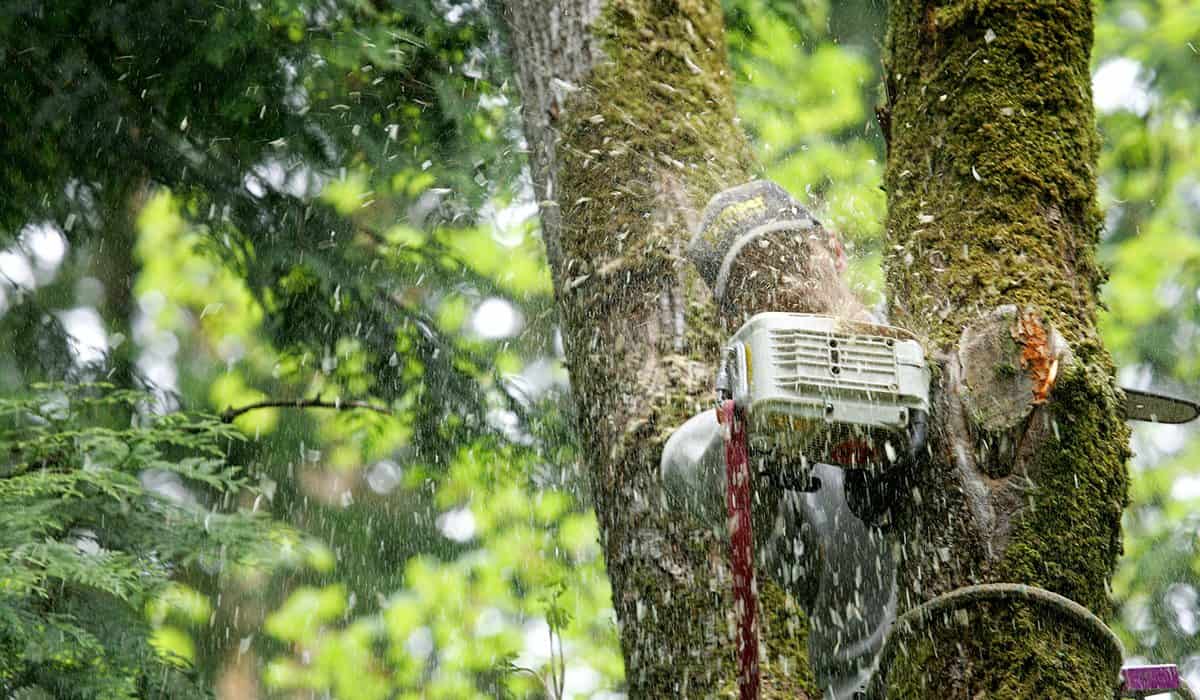
What does storm damage tree removal actually involve?
Storm damage tree removal is different from a standard removal job in a few important ways. After a storm, trees may be partially uprooted, split, or hanging over structures — which changes the risk profile of the removal significantly. A tree that’s leaning against your house or tangled in a power line requires different equipment and a different approach than a healthy tree being removed on a clear day.
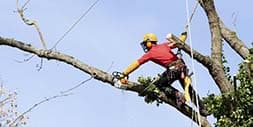
This is where equipment matters. Removing a large, storm-damaged tree near a structure isn’t a job for a crew with a ladder and a chainsaw. It requires proper rigging, the right lift equipment, and experienced judgment about how a compromised tree will move when you start cutting. A 50-inch aerial bucket, for example, gives a crew access to heights and angles that a standard lift can’t reach — which is the difference between a controlled removal and a situation that gets worse before it gets better.
There’s also the scam factor, which is real and well-documented in Nassau County. After major storms, door-to-door crews appear offering fast, cheap removal — cash only, no written estimate, no proof of insurance. The BBB has specifically warned about this pattern: these operators often lack proper equipment, licensing, and insurance, and homeowners who hire them can end up with incomplete work, property damage, and no legal recourse. A company you’ve already vetted and have a relationship with before the storm is your best protection against that scenario.
The other thing worth understanding is that not every storm-damaged tree needs to come down immediately. A certified arborist can assess whether a damaged tree is structurally salvageable or genuinely hazardous — and that distinction matters both for your property and for your wallet. Removing a tree that could have been saved is an unnecessary cost. Leaving one that should have come down is a liability.
Does homeowner's insurance cover storm damage tree removal in Nassau County?
This is one of the most common questions Nassau County homeowners have, and the answer is more complicated than most people expect. Whether your homeowner’s insurance covers tree removal after a storm depends heavily on the circumstances — specifically, whether the tree caused damage to a structure, and whether you can demonstrate that you weren’t aware of a pre-existing hazard.
That second part is where things get tricky. If an insurer can show that a tree was visibly dead, diseased, or structurally compromised before the storm, and that you hadn’t addressed it, they may deny the claim or reduce the payout on the grounds of negligence. This isn’t a hypothetical — it’s a real pattern that plays out after major storms on Long Island. The neighbor who pointed out that tree two years ago, the arborist report you didn’t follow up on, the dead branches that were visible from the street — these details matter when a claim is under review.
Proactive removal or documented maintenance works in your favor in that scenario. It demonstrates that you were managing the risk, not ignoring it. And in Nassau County’s dense residential neighborhoods, where a failing tree can land on your roof, your neighbor’s fence, their car, or a shared property line, the liability question isn’t just about your insurance — it’s about your relationship with the people next door.
Getting a written assessment from a certified arborist before storm season gives you documentation. It gives you a clear picture of what needs to come down, what can stay, and what the actual risk profile of your property looks like. Small trees under 20 feet typically run $300–$800 to remove, while large trees near structures or power lines can run $1,500–$3,000 or more. Knowing that before a storm — when you have time to plan and compare estimates — is a very different situation than finding that out at 7am after a nor’easter.
The right time to find a tree service near you is before you need one
Nassau County gets hit from multiple directions — nor’easters off the Sound, tropical storms tracking up the coast, the occasional direct hit that reminds everyone how serious storm season actually is. The homeowners who come through it with the least damage and the least stress are almost always the ones who made a call before the forecast showed anything.
Vetting a tree service when you’re not in crisis mode means you have time to check credentials, ask the right questions, compare estimates, and choose based on quality rather than availability. That’s a much better position to be in than calling around after a storm and taking whoever picks up first.
If you’re a Nassau County homeowner and you’re not sure whether the trees on your property are actually ready for storm season, we at Competition Tree, Inc. offer free estimates and have been doing this work on Long Island for over 22 years. That’s a good place to start.
Article details:
- Published by:
- Competition Tree
- Published to:
- Last modified:
- September 23, 2026
Share:
Continue learning: