Neighbor’s Tree Fell on Your Property? New York Rules Explained
A tree just landed on your property and you're not sure who's responsible. Here's what New York law actually says — and what to do first.
Share:
Summary:
A tree just came down on your side of the fence. Maybe it clipped your roof. Maybe it flattened your fence entirely. Your first instinct is probably to knock on your neighbor’s door — and honestly, that instinct makes sense. It was their tree.
Here’s the thing: in New York State, that conversation may not go the way you expect. The law around neighbor tree damage is specific, and most homeowners don’t know how it works until they’re standing in the middle of exactly this situation. If the fallen tree needs immediate attention, professional tree removal can help address the hazard safely. This page explains what New York actually says, what your insurance covers, and what you should do in the next 24 hours.
Who Is Responsible When a Neighbor's Tree Falls on Your Property in New York?
The short answer is: usually you. That surprises most people, but it’s how New York law works.
The governing standard comes from a 1985 New York Court of Appeals case, Ivancic v. Olmstead, which established what’s known as the Prior Notice Doctrine. Under that doctrine, a property owner is not automatically liable when their tree falls outside their property and causes damage. Liability only attaches if the tree’s owner had actual or constructive knowledge that the tree was dangerous — and did nothing about it.
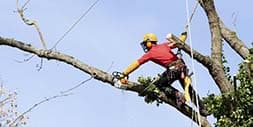
What that means in plain terms: if a healthy tree blows over during a storm, that’s treated as an act of nature. Your own homeowners insurance becomes the first line of coverage, not your neighbor’s. Your neighbor is only on the hook if you can demonstrate they knew — or reasonably should have known — that the tree was a hazard before it fell. If a hazardous tree needs attention before it becomes a bigger problem, professional tree trimming may help reduce the risk.
What Does "They Should Have Known" Actually Mean?
This is where the law gets more nuanced — and where a lot of neighbor tree disputes actually have more merit than homeowners realize.
“Constructive notice” is the legal term for what a reasonable person should have observed. If your neighbor’s tree was visibly dead, had large sections of bark falling off, showed fungal growth at the base, had a severe lean toward your property, or had hollow sections visible from the ground, a court could find that the hazard was “readily observable.” You don’t need a professional arborist’s report to establish constructive notice — the defect just needs to be something an ordinary person walking past the tree would have recognized as a problem.
“Actual notice” is more straightforward: someone told them. If you sent your neighbor a letter, an email, or even had a documented conversation warning them that the tree looked dangerous, that creates actual notice. The more formal the documentation — a certified letter, a written complaint to the town — the stronger your position.
The distinction matters because it determines whether you’re filing a claim through your own insurance or pursuing your neighbor’s. If you’ve been warning your neighbor about a dead tree for months and they ignored it, you may have a legitimate negligence claim. If the tree looked perfectly healthy and a nor’easter took it down overnight, you’re almost certainly looking at your own policy.
One important nuance: even when a storm is involved, the storm doesn’t automatically let the tree’s owner off the hook. If the tree was already structurally compromised before the storm hit, the storm becomes the event that triggered the fall — not the cause of it. Courts have recognized this distinction, and it’s why getting an ISA-certified arborist to assess the fallen tree’s condition before it’s removed can matter significantly to the outcome of any liability dispute.
Tree Fell on House: What to Do Before Anyone Removes Anything
If a tree has come down on your house, the sequence of what you do in the next few hours matters more than most people realize. The instinct is to get the tree off the roof as fast as possible — and yes, safety and preventing further damage are real priorities. But clearing debris before you’ve documented the scene can cost you in ways that aren’t obvious until later.
Start with photographs. Take as many as you can from multiple angles — the fallen tree, the point of impact, the damage to the structure, and ideally the root ball or the stump if it’s still standing on your neighbor’s property. If the tree appeared dead or diseased before it fell, photograph that too. Bark condition, fungal growth, hollow sections — all of it. This documentation becomes your evidence for the insurance claim and, if applicable, for any negligence case against your neighbor.
Then call your homeowners insurance company. Even if you believe your neighbor is liable, your insurer needs to be notified promptly. Most policies have reporting requirements, and delays can complicate your claim. Your insurer may also pursue subrogation — meaning they pay you first, then seek reimbursement from your neighbor’s insurance if negligence can be established. That process happens behind the scenes, but it only works if the claim is filed correctly from the start.
After that, call a licensed tree service. Not to clear everything immediately, but to assess the situation and make it safe. A tree pinning a corner of your roof creates ongoing structural risk — water intrusion, load-bearing stress, secondary collapse. Getting a professional out quickly to stabilize the situation is the right call. In Nassau County, where quarter-acre lots mean a neighbor’s tree is almost always close enough to reach your structure, this kind of response time matters. We offer free on-site estimates and 24/7 emergency availability, so the call can happen the moment you need it — not when an office opens Monday morning.
Tree Fell on Fence: Who Is Responsible?
Fence damage is actually the most common scenario we see in Nassau County. The lots here are dense — a quarter-acre in Levittown or Hicksville puts your neighbor’s oak about twenty feet from your fence line — and when a limb or a full tree comes down along the property boundary, the fence is usually the first casualty.
The same negligence standard applies: if the tree was healthy and a storm brought it down, your homeowners insurance handles the fence. If the tree was visibly compromised and your neighbor ignored it, you have grounds for a negligence claim. But there’s an additional wrinkle with fences that homeowners often don’t anticipate.
How Homeowners Insurance Handles Fence Damage from a Fallen Tree
Fences fall under what’s called “other structures” coverage in a standard homeowners policy. This is separate from your dwelling coverage, and it’s capped — typically at 10% of your dwelling coverage limit. So if your home is insured for $400,000, you have $40,000 in coverage for fences, sheds, and detached garages combined. For most fence repairs after a fallen tree, that’s sufficient. But if the same storm event damaged your fence, your detached garage, and a storage shed, you could find yourself bumping against that cap.
There’s another coverage limitation worth knowing. If a tree falls in your yard and damages nothing — no structure, no fence, no covered surface — most standard policies will not cover the cost of removing it. The coverage for tree removal generally only kicks in when the tree has damaged a covered structure, or in some cases when it’s blocking a driveway or primary entrance. Even then, the maximum most policies pay toward removal is around $500. That’s a meaningful gap when actual removal costs for a large tree in a tight Nassau County yard can run considerably higher.
This is why the documentation sequence matters so much. If the tree grazed your fence on the way down and you clear it before documenting the contact point, you may lose the ability to file a valid claim under your other structures coverage. Photograph the fence damage, the fallen tree, and the point of contact before any cleanup begins. Your insurance adjuster will want that evidence, and so will you if the claim gets disputed.
If your neighbor’s negligence is the issue — meaning the tree was clearly dead or diseased and they ignored it — you can file the claim through your own insurance and let the subrogation process work, or you can pursue your neighbor’s liability coverage directly. Either way, having a written record of any prior complaints you made about the tree strengthens your position considerably.
Nassau County-Specific Factors That Affect Neighbor Tree Damage Claims
Nassau County has some specific conditions that make neighbor tree damage more common here than in a lot of other markets — and a few local factors that affect how removal and liability situations get resolved.
The housing stock is a big part of it. Most of Nassau County’s neighborhoods were built in the decade after World War II — the median build year across the county’s roughly 482,000 housing units is around 1955. That means the trees on those properties have had 60 to 80 years to grow large. A red oak that was a sapling when a Cape Cod in Massapequa was built in 1952 is now a 70-foot tree with a canopy that reaches well past the property line. These are not small trees. When they come down, they cause real damage.
Storm exposure compounds the issue. Nassau County sits in the path of weather systems from multiple directions. The South Shore communities — Long Beach, Freeport, Oceanside, Rockville Centre — face Atlantic storm surge and hurricane-force winds from the southeast. The North Shore communities — Great Neck, Port Washington, Manhasset, Oyster Bay — take the full force of nor’easters driving down Long Island Sound. Central Nassau, including Levittown, Hicksville, Garden City, Mineola, and Westbury, sees primarily wind-driven damage. Anyone who was here for Hurricane Sandy in 2012 or Tropical Storm Isaias in 2020 knows exactly what this county looks like after a significant storm event.
There’s also a permit layer that catches homeowners off guard. Tree removal permitting in Nassau County varies by municipality. In the Town of North Hempstead, for example, a permit is required for any front-yard tree with a trunk diameter of six inches or more, measured at four and a half feet above the base. Contractors applying for those permits must hold a Nassau County Home Improvement Contractor License. Even in an emergency situation following a fallen tree, permit requirements don’t simply disappear. Working with a licensed contractor who knows the local regulatory landscape means you don’t end up with a code violation on top of everything else. We operate across Nassau County and carry all required licensing — it’s not something you should have to figure out on your own when you’re already dealing with a downed tree on your property.
What to Do After a Neighbor's Tree Falls on Your Nassau County Property
The biggest mistake homeowners make in this situation is assuming the answer is obvious — either the neighbor pays or they don’t — and acting on that assumption before they have the full picture. New York law is specific, the insurance mechanics have real limitations, and the steps you take in the first 24 hours genuinely affect what you can recover.
Document before you clear. Notify your insurer promptly. Get a professional assessment of the fallen tree’s condition if there’s any question about whether it was healthy before it came down. And work with a licensed, insured contractor who understands Nassau County’s permit requirements — not just someone who shows up with a truck.
If you’re in the middle of this situation right now, Competition Tree, Inc. offers free on-site estimates and emergency availability around the clock. We’ve been doing this work on Long Island for over 22 years, our arborists hold ISA certifications, and we carry full licensing and insurance with proof available before any work begins. Give us a call — we’ll help you understand exactly what you’re dealing with and what the right next step looks like.
Article details:
- Published by:
- Competition Tree
- Published to:
- Last modified:
- September 30, 2026
Share:
Continue learning: