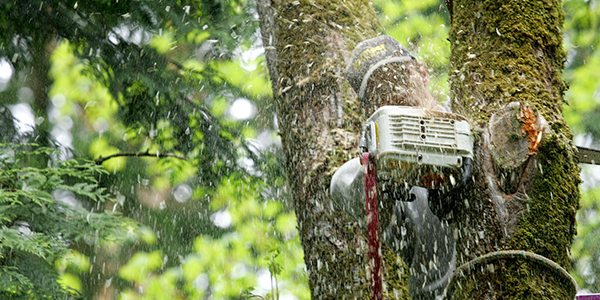
Why Tree Topping Damages Your Trees Permanently
Tree topping sounds like a quick fix, but the damage it causes is anything but temporary. Here's what Nassau County homeowners need to know before calling anyone.
Share:

Summary:
If you’ve got a big tree close to your house — especially after a rough storm season — the idea of cutting it down to size makes complete sense. Someone may have even quoted you “topping” as the solution. It sounds straightforward. It isn’t.
Tree topping is one of the most damaging things you can do to a tree, and the harm doesn’t show up all at once. It builds. Over the next few years, what looked like a quick fix turns into a hazard, a money pit, or both. Here’s what’s actually happening inside that tree — and what a better approach looks like.
What Tree Topping Actually Does to a Tree
Topping means cutting a tree’s main branches down to stubs — removing large sections of the canopy all at once to reduce height. It looks dramatic, and in the short term, it does make the tree smaller. That’s the only thing it does well.
The problem starts immediately. Those large cuts don’t heal the way smaller pruning cuts do. The tree’s natural defense system — the process arborists call compartmentalization — gets overwhelmed by wounds that are simply too large to seal off properly. That leaves the tree exposed to decay, fungal infection, and insects for years.
What follows is a cycle most homeowners don’t anticipate. And by the time it becomes obvious, the damage is already done.
Why Topped Trees Become More Dangerous Over Time
Here’s the part that surprises most people: topping a tree for safety reasons tends to make it less safe, not more.
When a tree loses most of its canopy, it responds by pushing out what arborists call watersprouts — fast-growing shoots that can reach 20 feet in a single season. These look like new growth, but they’re structurally weak. They attach at the surface of the wood rather than growing from within it, which means they break far more easily than the original branches ever would have. During a nor’easter or a strong summer storm — exactly the conditions Nassau County homeowners are trying to prepare for — those watersprouts become the hazard.
There’s also the issue of root imbalance. A tree’s root system develops over decades to support its full canopy. When you remove most of that canopy at once, the root system is now oversized relative to what’s above ground. That imbalance can affect how the tree stands under load. It’s not an immediate collapse risk, but it’s a structural reality that matters when 60-mile-an-hour winds are moving through Levittown or Long Beach.
Beyond the structural issues, topped trees are significantly more vulnerable to disease. Open wounds from large cuts attract bark beetles. Those beetles can carry pathogens like oak wilt — a serious concern for the mature oaks that line so many Nassau County streets and backyards. The sunscald that follows topping, where previously shaded bark gets suddenly exposed and cracks, creates additional permanent entry points for infection.
Dr. Alex Shigo, one of the most respected scientists in the history of arboriculture, described tree topping as “the most serious injury you can inflict on a tree.” That’s not an exaggeration. It’s a summary of what the research consistently shows.
The Long-Term Cost Most Homeowners Don't See Coming
There’s a financial argument here that doesn’t get talked about enough, especially in a market like Nassau County where property values are serious business.
Topped trees don’t stay small. The watersprouts that follow topping grow back aggressively, often returning the tree to its original size within a few years — but now with a weaker, messier structure. That means whoever topped your tree will likely be back to top it again. And again. Each round costs money, and none of it is improving the tree’s condition. You’re paying repeatedly to manage a problem that’s getting worse underneath the surface.
Eventually, many topped trees reach a point where removal is the only safe option. At that point, you’ve paid for multiple rounds of topping, and now you’re facing the cost of full removal on top of it. That’s the financial cycle that proper pruning avoids entirely.
Healthy, well-maintained trees can add 10 to 20 percent to a property’s value. Topped trees do the opposite — they reduce curb appeal, signal neglect to buyers, and in some Nassau County municipalities, may actually violate local tree preservation ordinances. Some incorporated villages on Long Island require permits for significant tree work, and HOAs in certain communities explicitly prohibit topping because of how it affects neighborhood appearance.
If you’re in a community like Garden City, Great Neck, or Manhasset — where properties are significant investments and neighbors notice — the visual difference between a properly pruned tree and a topped one is not subtle. Topped trees have an unmistakable stubby, hollowed-out look that doesn’t grow out of. That shape is the permanent result of where the cuts were made.
Proper Tree Pruning Techniques That Actually Solve the Problem
The goals behind topping — reducing height, managing size, lowering storm risk — are all achievable through proper pruning. The difference is in how the cuts are made and where.
Proper tree pruning works with the tree’s biology instead of against it. Cuts are made to lateral branches, not to stubs, which allows the tree to seal the wound naturally and maintain its structural form. The result is a smaller, safer tree that still looks like a tree.
This is what ISA-certified arborists are trained to do, and it’s what the ANSI A300 standards — the legal benchmark for tree care quality in the United States — require. Tree topping is explicitly identified in those standards as an unacceptable pruning practice.
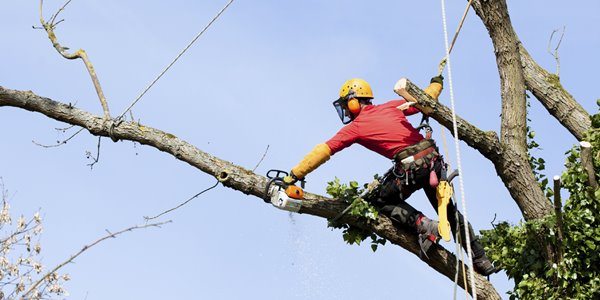
Crown Reduction vs. Tree Topping: What's the Actual Difference?
Crown reduction is the technique that does what most homeowners think topping does — it makes the tree meaningfully smaller — without the structural and biological damage.
The key distinction is where the cut happens. In crown reduction, each branch is cut back to a lateral branch that’s at least one-third the diameter of the limb being removed. That lateral branch then becomes the new end point of that stem, and the tree’s energy flows naturally through it. The canopy looks proportional, the structure stays sound, and the tree can seal the wound on its own over time.
Topping, by contrast, cuts branches to arbitrary stubs with no lateral branch to redirect growth. The tree has no natural way to respond to that kind of wound except to push out those fast-growing, weakly attached watersprouts. The ANSI A300 standard’s 25 percent rule — which limits any single pruning session to removing no more than a quarter of the live crown — exists precisely because trees need their canopy to photosynthesize and sustain themselves. Topping routinely removes 50 to 100 percent of the crown at once.
For Nassau County homeowners dealing with mature oaks, red maples, or Norway maples that have grown into their rooflines or power line clearances, crown reduction is the answer. It’s the approach we use when a customer calls and says their tree is too close to the house — because that’s a legitimate concern, and it deserves a real solution, not a shortcut that creates a bigger problem three years from now.
Tree Health Maintenance After Proper Pruning: What to Expect
One of the questions we hear often is: after proper pruning, how much work does the tree actually need going forward?
The honest answer is significantly less than a topped tree. A tree that’s been properly pruned with good technique maintains its structure, seals its wounds naturally, and doesn’t respond with the explosive, uncontrolled regrowth that follows topping. In most cases, a well-pruned tree on a Nassau County residential property needs attention every three to five years, depending on the species and how close it is to structures.
Deadwooding — removing dead, dying, or structurally compromised branches — is often part of ongoing tree health maintenance and something that can be done on a regular schedule without stressing the tree. Crown thinning, which selectively removes interior branches to improve airflow and light penetration, is another technique that keeps trees healthy without reducing their overall size dramatically. These are the kinds of visits that keep a tree in good shape for decades.
Post-Sandy Long Island is a good reference point here. The trees that failed catastrophically during that storm were disproportionately the ones that had been stressed — by disease, by previous bad pruning, by root damage. Trees that had been maintained properly, with their canopy intact and their structure sound, handled the wind load far better. That’s not a coincidence. A healthy tree with an intact, balanced canopy actually performs better in storms than a topped one with a mass of weakly attached watersprouts.
For homeowners in coastal Nassau communities like Oceanside, Freeport, or Atlantic Beach, where storm exposure is a real annual concern, this matters. The instinct to top a tree before hurricane season is understandable — but the science goes the other direction. Proper pruning that removes dead wood, balances the canopy, and reduces wind resistance without destroying the tree’s structure is what actually lowers your risk.
We’ve been doing this work on Long Island for over 22 years. We’ve seen the aftermath of both approaches. The trees that were properly maintained are still standing. A lot of the topped ones aren’t.
Choosing the Right Tree Care Approach for Your Nassau County Property
If you’re looking at a large tree and wondering what to do with it, the most important thing you can do is get advice from someone who will tell you the truth — not just quote you the easiest job.
Tree topping is still offered by plenty of companies because it’s fast and profitable. That doesn’t make it the right call for your tree or your property. Proper pruning takes more skill, more care, and a real understanding of how trees respond to cuts. But it’s the approach that actually solves the problem without creating three new ones.
If you’re in Nassau County and you want a straight answer about what your tree actually needs, we’ve been giving those answers on Long Island since 1998. We’ll come out, take a look, and tell you exactly what we see — no pressure, no upsell, just an honest assessment and a fair price. Reach out for a free on-site estimate and find out what proper tree care looks like when it’s done right.
Article details:
- Published by:
- Competition Tree
- Published to:
- Last modified:
- August 25, 2026
Share:
Continue learning: