Fall Tree Maintenance on Long Island: Your Pre-Storm Checklist for Nassau County
A zone-by-zone fall checklist for Nassau County homeowners — what to inspect, what to act on, and when the window closes before storm season hits.
Share:

Summary:
Most Nassau County homeowners don’t think about their trees until something goes wrong — a branch scraping the roof during a rainstorm, a neighbor’s oak coming down on a shared fence, or that sick-looking maple that’s been leaning a little more each year. By then, the options get more expensive and the wait times get longer. Fall is the window that changes that equation. Before the ground freezes, before the nor’easters start stacking up, and before every tree crew on Long Island is backed up for weeks — this is the time to walk your property, know what you’re looking at, and make a plan.
Why Fall Is the Right Time for Tree Pruning Services Near Me in Nassau County
There’s a reason arborists consistently recommend fall as the optimal window for structural tree work, and it’s not just about scheduling. When trees go dormant, their branch architecture becomes fully visible — no foliage blocking the view of dead limbs, weak attachments, or canopy sections that have quietly been dying back all summer. That visibility matters when you’re trying to assess what’s actually dangerous versus what just looks rough.
There’s also a practical deadline most homeowners don’t think about until it’s too late. Once the ground freezes — typically arriving in December or January across Nassau County — heavy equipment becomes difficult to move across residential lawns without causing damage. Large-scale tree work gets harder, slower, and more expensive. The fall window, realistically September through mid-October, is when scheduling is still flexible and the work can be done right.
The Booking Reality Nassau County Homeowners Learn the Hard Way
After a significant nor’easter moves through Nassau County, the phones at every reputable tree service ring off the hook. Homeowners who were meaning to deal with that overhanging oak or that split-crotch maple suddenly need it handled immediately — and they’re competing with hundreds of other callers in the same position. The wait time from a legitimate, insured company can stretch to several weeks. And the pricing reflects the demand.
This is not speculation. It’s how the market works on Long Island year after year. The homeowners who get the best pricing and the fastest turnaround are the ones who call in September, not the ones who call the day after a storm in November. The difference shows up in both the schedule and the bill.
There’s also the issue of who shows up after storms. The BBB has documented the door-to-door contractor problem repeatedly: unlicensed crews who canvass Nassau County neighborhoods after major weather events, quote low, collect a deposit, and either disappear or do work that creates new problems. Acting before the storm removes that entire category of risk. You get to choose your contractor on your timeline, check their credentials, request proof of insurance, and make a decision without pressure.
The math on pre-storm maintenance is also straightforward. Routine trimming and pruning costs a fraction of emergency removal. A small tree removal on Long Island might run $300 to $600. A large tree near a structure can cost $1,000 to $3,000 or more — and that’s before you factor in any roof, fence, or car damage it causes on the way down. The preventive work almost always costs less than the emergency response.
What to Actually Look for When You Walk Your Property This Fall
The most common mistake homeowners make is treating a visual inspection like a health check. If the tree is green and upright, it seems fine. But structural integrity and surface appearance are two different things — especially in Nassau County’s coastal communities like Atlantic Beach, Island Park, and Baldwin Harbor, where chronic salt air exposure can weaken bark and stress root systems in ways that don’t show up until a tree is already failing.
Start at the roofline. Walk the perimeter of your house and look up. Any branch that extends over the roof, the gutters, or the chimney is a liability in a storm with 50 to 70 mph gusts. You don’t necessarily need to remove those trees — targeted trimming to establish clearance is often enough. But you need to know they’re there and have a plan.
Move to the trunk. Look for cracks, splits, or sections of bark that look sunken, discolored, or hollow-sounding if you knock on them. Fungal growth at the base of a tree — mushrooms, shelf fungi, or dark soft spots — is one of the clearest indicators of internal decay. A tree can look completely normal from twenty feet away and be structurally compromised at the root collar.
Check the canopy for deadwood. Dead branches in the upper canopy are easy to miss when the tree is in full leaf, but as foliage thins in October, they become visible — dry, brittle limbs with no leaf growth that snap instead of bend. In a nor’easter, these come down. The question is whether they come down on your lawn or on your roof.
Finally, look at the lean. A tree that has gradually shifted its angle over the past few seasons, particularly one with surface roots that are lifting on one side, may have a compromised root system. This is the category where a professional assessment matters most — it’s not something a homeowner can reliably evaluate without knowing what they’re looking for.
Tree Trimming Service Near Me: What the Work Actually Involves
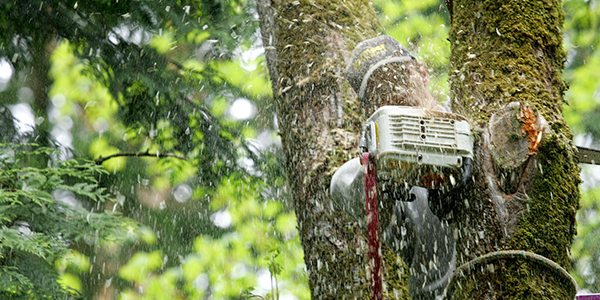
When most people search for a tree trimming service, they’re picturing someone with a chainsaw cleaning up the obvious stuff. The reality of professional tree work is more involved, and understanding what’s actually happening helps you evaluate whether a company is doing the job right or just going through the motions.
Professional trimming and pruning follow established standards — specifically ANSI A300, the industry benchmark for tree care management. One useful test when you’re comparing companies: ask what pruning standard they follow. A professional will know the answer. Someone who doesn’t is telling you something important.

Trimming vs. Pruning — Does the Difference Actually Matter?
In casual conversation, trimming and pruning get used interchangeably. In practice, they describe different objectives. Trimming is primarily about clearance and aesthetics — removing branches that overhang structures, crowd power lines, or extend beyond the natural shape of the tree. It’s reactive work, driven by what’s in the way.
Pruning is structural. It’s about the long-term health and integrity of the tree — removing dead, diseased, or crossing branches that create weak points, improving airflow through the canopy, and shaping the tree so it distributes weight evenly. Done correctly by a certified arborist, pruning extends the life of a tree and reduces its storm risk profile. Done incorrectly — or not done at all — the tree accumulates structural problems that compound over time.
For Nassau County homeowners with mature trees, the distinction matters practically. Many of the oaks, maples, and beeches on Long Island’s post-war housing lots are now 50 to 70 years old. These trees are at the stage where structural pruning is the difference between a tree that stands for another 30 years and one that becomes a liability. A certified arborist can tell you which category your trees are in — and that assessment is worth getting before storm season, not after.
A legitimate tree service will not recommend removing every tree they look at. The goal of a professional assessment is to identify what can be saved with proper care and what genuinely needs to come down. We employ certified arborists specifically because that judgment call requires real expertise — and because homeowners deserve an honest answer, not a removal recommendation driven by the size of the invoice.
Tree Care Near Me: What a Full-Service Visit Actually Covers
Beyond trimming and pruning, a full-service tree care visit covers more ground than most homeowners expect. Disease inspection is part of the picture — oak wilt, for example, is a documented concern for Long Island’s red oak population, and catching it early changes the outcome significantly. A trained eye looking at your trees in fall can identify signs of disease, pest activity, or structural decline that a homeowner would reasonably miss.
Stump grinding is another component that often gets deferred and then forgotten. Old stumps left in the yard don’t just look rough — they can harbor disease and pests that spread to nearby healthy trees. We grind stumps 6 to 12 inches below ground level, which is deep enough to allow grass or landscaping to grow over the area cleanly.
For complex jobs — trees close to rooflines, near power lines, or in tight spaces between structures — the equipment matters. We have a 50-inch aerial bucket available for situations where ground-level access isn’t sufficient, along with a full fleet of trucks capable of handling any size job. This equipment set is something not every Nassau County tree service can deploy, and it’s relevant when the tree that needs work happens to be the one that’s most difficult to reach.
After every job, we haul everything out — branches, logs, wood chips, sawdust — and rake the area clean. We also offer free wood and wood chips to homeowners who want them. If you heat with wood or want mulch for your garden beds, it’s yours at no charge.
The free estimate is the logical starting point for all of this. We typically have estimates available within a day, and you don’t need to be home for the assessment. Over 23 years of working across Nassau and Suffolk County means we’ve seen nearly every tree situation Long Island can produce — and the estimate reflects that experience, not a number pulled from a rate sheet.
How to Get Your Nassau County Trees Ready Before Storm Season
The window for fall tree maintenance on Long Island is real and it closes faster than most homeowners expect. Once nor’easter season arrives and emergency calls start stacking up, the scheduling flexibility disappears and the pricing changes with it. The homeowners who act in September and October get the work done on their terms — with the right crew, at routine pricing, before the ground freezes and the options narrow.
Walk your property this week. Look at what’s overhanging the roofline, check the trunks for visible decay, and note any trees that have shifted their lean since last year. If something looks off, or if you simply want a professional eye on trees you’ve been watching for a while, that’s exactly what a free estimate is for.
Competition Tree, Inc. has been serving Nassau and Suffolk County for over 23 years. If you’re ready to get ahead of storm season, reach out — we’ll take a look and give you a straight answer about what your trees actually need.
Article details:
- Published by:
- Competition Tree
- Published to:
- Last modified:
- August 26, 2026
Share:
Continue learning: