Essential Fall Tree Care Near Me for Winter
Fall is the right time to get your trees ready for winter on Long Island — here's what Nassau County homeowners need to know before the first nor'easter arrives.
Share:
Summary:
If you own a home in Nassau County, you already know what a bad nor’easter can do. A mature oak that looked fine in September can become a serious problem by February — especially if nobody checked it before the ground froze and the storms started stacking up.
Fall tree care isn’t about being overly cautious. It’s about knowing what’s on your property, catching problems early, and making smart decisions before winter takes the choice away from you. This guide covers the essentials — what to look for, when to act, and why the timing matters more than most people realize.
Fall Tree Maintenance Essentials for Nassau County Homeowners
Nassau County’s housing stock is old — the average single-family home here was built around 1955. The trees on those properties are often just as mature, and with age comes structural complexity that a quick visual scan from the driveway won’t catch. A certified arborist can identify what’s actually going on: hidden decay, compromised branch unions, root stress from decades of freeze-thaw cycles, or early signs of disease that are much cheaper to treat than to deal with after a failure.
Fall is also when Long Island’s coastal exposure starts to matter. The salt air along the South Shore from Long Beach to Massapequa affects tree bark and root health differently than the wind-driven conditions North Shore communities like Oyster Bay and Great Neck face from Long Island Sound. Knowing your trees — and where you live in Nassau County — changes what good fall maintenance actually looks like.
Tree Dormant Season Care: Why the Timing Window Matters
Most people assume spring is the right time to deal with trees. It makes intuitive sense — everything is growing, the weather is better, and the damage from winter is visible. But for most tree species, late fall through early February is actually the optimal window for pruning. Trees are dormant, which means they heal more efficiently from cuts, and the risk of spreading disease is significantly lower because most pathogens are also dormant.
For oaks specifically — one of the most common species on Nassau County properties — the dormant window isn’t just preferable, it’s important. Oak wilt, a serious fungal disease, spreads readily through fresh pruning wounds when the tree is actively growing. Pruning between November and February dramatically reduces that risk. The same logic applies to elms, which are vulnerable to Dutch elm disease during the growing season.
There’s also a practical advantage that doesn’t get mentioned enough: when the leaves are down, the tree’s structure is fully visible. A good arborist can assess branch architecture, spot dead wood, identify weak or co-dominant leaders, and make better decisions about what needs to come out. Trying to do that same assessment in July, when the canopy is full, means working with incomplete information.
One more thing worth knowing: pruning too late in fall — say, early October in Nassau County — can sometimes stimulate new growth that doesn’t have enough time to harden off before the cold arrives. That new growth becomes vulnerable to frost damage, which creates the exact kind of wound you were trying to avoid. Timing matters in both directions.
How to Spot a Tree That's a Real Winter Risk on Long Island
Not every tree that looks a little rough is a hazard. But some warning signs are worth taking seriously before winter arrives, and a few of them are easy to spot without any specialized training.
Dead branches in the upper canopy are one of the clearest indicators. They’re heavier than they look, and when ice accumulates on them — which happens regularly during Nassau County winters — the weight can cause failures that a healthy branch would handle without issue. If you’re seeing significant deadwood in a tree that’s close to your house, your car, or a fence line, that’s worth a professional opinion before the first major storm.
A visible lean that has developed over time — not just the natural lean some trees grow into, but a change you’ve noticed in the last year or two — can indicate root system problems. Nassau County’s dense residential lots mean root systems are often competing with foundations, driveways, and utilities, and that competition can compromise stability in ways that aren’t obvious until a tree is under load from wind or ice.
Cracks or splits in the trunk or major limbs, fungal growth at the base of the tree, and bark that’s peeling or discolored in unusual patterns are all signs that something is happening below the surface. None of these automatically mean the tree needs to come down — a good arborist will give you an honest assessment of what’s actually going on and what the real options are. But ignoring them through the winter and hoping for the best isn’t a strategy. A tree impact through a roof in Nassau County runs $18,000 to $55,000 in structural repair, roof replacement, and interior damage remediation. A fall assessment costs nothing to schedule.
Tree Winter Preparation: What to Do Before the Ground Freezes
Once the ground freezes, your options narrow considerably. Heavy equipment can’t move through a frozen yard without causing damage, scheduling gets compressed as everyone rushes to catch up, and any trees that needed work before winter are now going into the worst weather of the year without it. Fall is the window — and in Nassau County, that window runs roughly from mid-October through late November before conditions start working against you.
Beyond pruning, there are a few practical steps that make a real difference in how your trees come through the winter. Watering deeply before the ground freezes — around 10 to 15 gallons per tree throughout fall — helps root systems stay hydrated through the dry winter months. Applying a 3 to 5 inch layer of organic mulch around the base of the tree insulates the roots from the freeze-thaw cycles that cause the most stress. These aren’t complicated tasks, but they’re easy to skip when the weather is still mild and winter feels far off.
Should You Schedule Tree Care Before or After Leaf Drop in Nassau County?
This is one of the most common questions homeowners ask, and the honest answer is: both windows have value, but for different reasons.
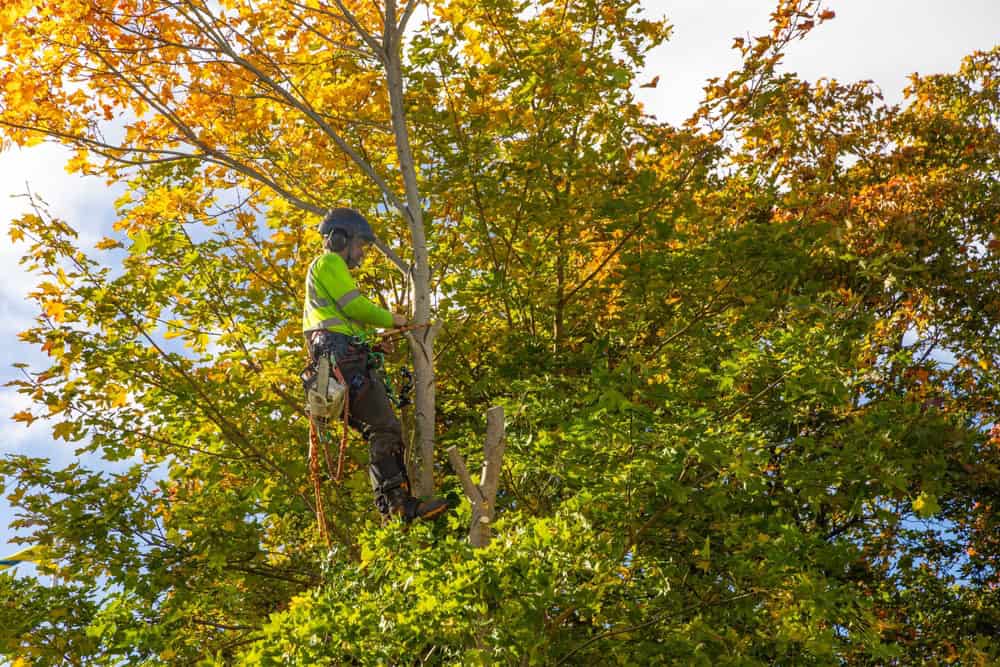
Before leaf drop — say, September through mid-October — is a good time to get an assessment done. The tree is still showing you its full canopy, which means you can see how the crown is filling out, whether there are areas of dieback or thinning, and how the overall health looks compared to previous years. If there’s an obvious hazard situation, catching it now gives you maximum flexibility on scheduling before the fall rush hits.
After leaf drop, typically mid-November in Nassau County, the structural picture becomes much clearer. Dead branches that were hidden by foliage are now visible. Weak branch unions, included bark, and co-dominant stems are easier to identify and assess. This is when most professional pruning work gets done, and it’s when you’ll get the most accurate picture of what the tree actually needs.
The practical issue is scheduling. Nassau County has a lot of mature trees and a lot of homeowners who all have the same idea at the same time. If you wait until December to call around, you may find that the companies worth hiring are already booked out, and the ones with immediate availability are the ones you should be skeptical of. Getting your estimate scheduled in October — even if the actual work happens in November or December — puts you ahead of the curve. We typically turn jobs around within a week of scheduling, but that depends on getting into the queue before the season peaks.
How to Choose a Tree Service Near You That's Actually Worth Trusting
This part matters more than most homeowners realize. The tree care industry in Nassau County — like most of Long Island — has a mix of legitimate, experienced companies and crews that work door-to-door following storms, carry minimal insurance, and move on before problems surface. The BBB and local district attorneys’ offices have issued repeated warnings about this, particularly targeting seniors and homeowners dealing with storm damage.
The two non-negotiables are insurance and certification. Any company you hire should carry both general liability and workers’ compensation insurance — and you should ask for a Certificate of Insurance, then call the insurer directly to confirm the policy is active before any work starts. This matters because if an uninsured worker is injured on your property, you can be personally liable for the claim. It’s not a hypothetical risk; it happens.
ISA Certified Arborists have passed a comprehensive exam covering tree biology, pruning, risk assessment, and worker safety, and they’re required to maintain their certification through continuing education. The certification rate across the broader tree care workforce is below 37%, which means most crews working in your neighborhood are not certified. That gap in training is reflected in the quality of the work — improper pruning cuts, poor rigging decisions, and missed disease signs are all more common when the person making the call isn’t qualified to make it.
Beyond credentials, pay attention to how a company communicates. Do they answer the phone? Do they show up for estimates when they say they will? Do they explain what they’re recommending and why, or just hand you a number? A company that’s been doing this work in Nassau County for over two decades has a reputation to protect and neighbors who can vouch for them. That accountability is worth something.
Ready to Schedule Fall Tree Care in Nassau County Before Winter?
Fall tree care on Long Island isn’t complicated, but it does have a timing component that most homeowners miss until it’s too late. The dormant window is real, the scheduling pressure is real, and the cost of skipping it — when a storm makes the decision for you — is significant.
The most useful thing you can do right now is get an assessment scheduled. Walk your property, note anything that looks off, and call a company that will actually show up, give you a straight answer, and tell you what needs to happen before winter. You don’t need to figure out the technical details yourself — that’s what the assessment is for.
If you’re in Nassau County and want a free on-site estimate from us, we’re available seven days a week. We answer the phone personally — including on weekends — and can typically get an estimate to you within a day.
Article details:
- Published by:
- Competition Tree
- Published to:
- Last modified:
- August 7, 2026
Share:
Continue learning: